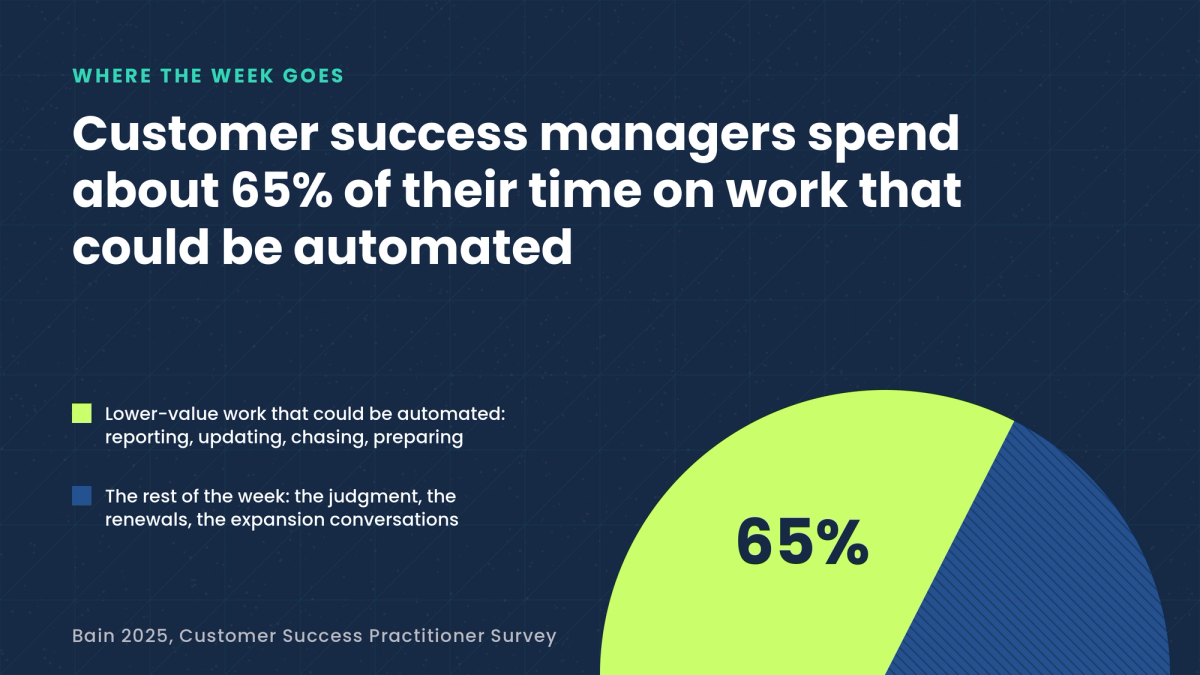
Bain found customer success managers spend about 65% of their time on work that could be automated, and net revenue retention fell even as companies hired more of them.
AI for Account Management vs Hiring More Account Managers: What the headcount data says.

Should we use AI for account management or hire more account managers?
Most heads of account management are being asked this question right now. The board has read the AI headlines and wants to know why next year's plan still has three more account managers in it. The head of account management has a book that has grown faster than the team, a team that covers the top hundred accounts well and the rest by exception, and a renewal calendar that will not wait for the debate to finish.
The evidence on both sides of the choice is already in, and it points the same way. Hiring more people has been tried at scale, and retention fell anyway. Replacing people with AI has been tried too, and the companies that did it are hiring people back. The teams that are ahead did something different from either: they identified what account work needs to be done, what the best way to do it is, and only then how it can be improve upon using AI.
Why hiring more account managers did not improve retention
Bain's Customer Success Practitioner Survey, fielded across 235 practitioners in August 2025 and published that December, put two findings side by side. The first is that customer success managers spend about 65% of their time on lower-value work that could be automated: reporting, updating the CRM, chasing replies, preparing for meetings. The second is that net revenue retention declined even as companies invested in hiring more customer success roles. Companies kept adding people, and retention kept falling.
The first finding explains the second. When a team hires another account manager, that person steps into the same job as everyone else on the team, and their week fills with the same reporting, updating, chasing and preparing. If Bain's figure holds for them, roughly two thirds of the capacity the company just paid for goes to that routine work, and only the remaining third reaches customers. A few more accounts get proper attention than before. The rest of the book is as unmanaged as it was, so retention does not improve, and payroll goes up.
This is the capacity problem that every post-sales leader knows: a team can only manage a fraction of its customer base, every other account is unmanaged or under-managed, opportunities in those accounts are missed, and some of them churn. For years, hiring more people was the only answer available. Bain's survey is the record of what happened when companies gave that answer at scale, and it is why the AI option looks so tempting to the board.
Why replacing account managers with AI does not work either
The tempting version of the AI option is to cut people and let the software do the work. That has been tested most visibly outside post-sales, and one example is worth giving because the mechanism carries over. Klarna cut its customer service staff from 5,500 to 3,400 and said its AI was doing the work of 700 agents. In May 2025 it reversed course and started hiring people again (reported by CX Dive and Forbes). The volume metrics it had been watching, resolution rate and handle time, had stayed healthy the whole time; what had decayed was the quality of the harder conversations, which those metrics could not see. Gartner now predicts that half of the companies that attributed customer service cuts to AI will be rehiring for the same functions by 2027.
An account management book has far more of those harder conversations than a support queue does. A renewal at risk because the sponsor changed, an expansion that depends on reading the politics of a procurement team, a customer who is unhappy and has said nothing in a ticket: these are the interactions that make up the value of the function, and they are exactly the ones a volume metric cannot see. A leader who cuts account managers to fund AI is betting that this work either does not matter or can be done by the tool, and the bet gets settled in the renewal quarter after the cut.
So hiring more people did not improve retention, and replacing them cost the judgment the book depends on. The teams that are ahead took a third route.
What the teams that are ahead did instead
ICONIQ's State of Software 2025 describes where those teams ended up. Go-to-market organizations at AI-native companies are 20 to 30% leaner and about nine times flatter than their traditional peers, with about twice the net-new revenue per rep. Within those leaner organizations, post-sales takes a larger share of the people: 31% of go-to-market headcount, against 23% at traditional SaaS companies. The companies furthest along with AI kept their account teams, gave them a bigger share of the headcount, and changed what those people spend their time on.
How they changed it is the interesting part. Leaders set a quantified ambition for the function, pick two or three processes to change first, redesign each of those processes from a blank slate around what AI can now do, and then retire the old dashboards so the team cannot drift back. The blank slate is the important part. Adding AI to the steps a person already follows leaves the steps in place, and with them the 65% of the week they consume. McKinsey's State of AI 2025 found the same thing from a different angle: redesigning the workflow around the AI is the single strongest predictor of AI showing up in earnings, and the companies seeing that impact are 2.8 times more likely to have done it.
Once the process is redesigned, the person's job changes too. TSIA's State of Customer Success 2026 describes the customer success manager becoming what TSIA calls a "value manager", where the old title was "trusted advisor". The core requirements become commercial confidence, data literacy and ownership of the customer's outcome, and compensation is increasingly tied to net revenue retention and growth where it used to be tied to satisfaction scores and activity. An account manager's title already carries the commercial half of that description, so the same shift applies to them.
Put together, the three findings describe a redesign of the account manager's job. The routine that Bain measured at 65% of the week, monitoring every account, drafting every first message, following up when nobody replies and updating the CRM after every interaction, is handed to the AI. The person keeps the work that needs judgment, the difficult renewal and the expansion conversation, and now has the hours to do that work across a much larger share of the book. The next question is what that hand-over looks like in a real team.
How Trig raises the number of accounts each person can cover
Trig is built for the redesigned version of the job. It is a Revenue AI that manages, retains and grows an entire customer base, and it does that by taking on the routine part of account work across every account at once, while the account manager keeps the part that needs judgment.
The routine part splits into four kinds of work, and Trig's AI Agents handle each of them:
- Monitoring every account. Agents track every customer's behavior against the milestones and outcomes the team cares about, and report what changed through daily summaries, weekly digests, or a snapshot an account manager pulls before a meeting. The accounts nobody had time to watch are now watched.
- Running the outreach. Agents draft and send the outreach, adapt it to how the customer responds, stop when the customer acts, and change approach or escalate when they do not. So the chasing that used to fill the afternoon can now run on its own.
- Alerting the right person. The moment an account needs human attention, an agent alerts the account owner with the context they need to act. The person is brought in when judgment is required, and no longer has to read everything to find those moments.
- Keeping the systems in sync. Agents log every action, update every field and trigger every workflow in the CRM and the other tools the team already uses, so nobody spends the end of the day on data entry.
The account manager stays in charge of all of this. Each piece of agent work is set up as a Job, which is the goal, the accounts it covers, how long it runs and which tools the agents may use. The team approves every Job before it starts, sets what agents may and may not do, and can pause or stop any Job at any time. That puts approval at the decisions where human judgment is needed and keeps the person's attention on the interactions where quality is at stake, which is the lesson from the companies that cut too far.
Consider what this looks like for an account management team of six covering 700 accounts, where today the top 120 get a quarterly review and the rest get a renewal email. After the redesign, agents monitor all 700, run a re-engagement Job on the accounts whose usage has fallen ahead of renewal, and alert the account owner when a flagged account replies or when the pattern suggests a sponsor has left. The six account managers spend their week on the conversations those alerts surface and on the expansion plays in the accounts that are growing. The book has not changed and neither has the headcount. What has changed is where the six people's hours go: to the hardest moments across all 700 accounts, where before they went to the routine ones in the top 120.
That change also has to be measurable, because otherwise the board's question comes back next quarter. Trig tracks how many customers entered a Job, how many completed it and how long it took, and estimates the uplift by comparing the customers a Job targeted against similar customers it did not. That comparison is what lets a head of account management say what the redesign did to retention in the accounts the team was never reaching, in numbers finance recognizes.
What this means for the team
A head of account management who is asked to choose between AI and more people can now answer with the evidence. Adding people to the same job did not improve retention, and removing people in favor of the tool costs the judgment the book depends on. The teams that are ahead redesigned the work instead: AI carries the monitoring, the outreach, the follow-up and the system updates across every account, and the account manager carries the judgment across a much larger share of the book. Once the work is split that way, the headcount conversation turns into a coverage conversation: how many of the accounts are managed, by which combination of people and agents, and what happened to retention in the accounts that were never managed before.