Gartner estimates only about 130 of the thousands of vendors describing their products as agentic are real. Five questions separate a native agent from a rebranded assistant.
Customer Success Software with native AI agents: How to tell a real agent from a rebranded assistant

Which customer success software actually has native AI agents?
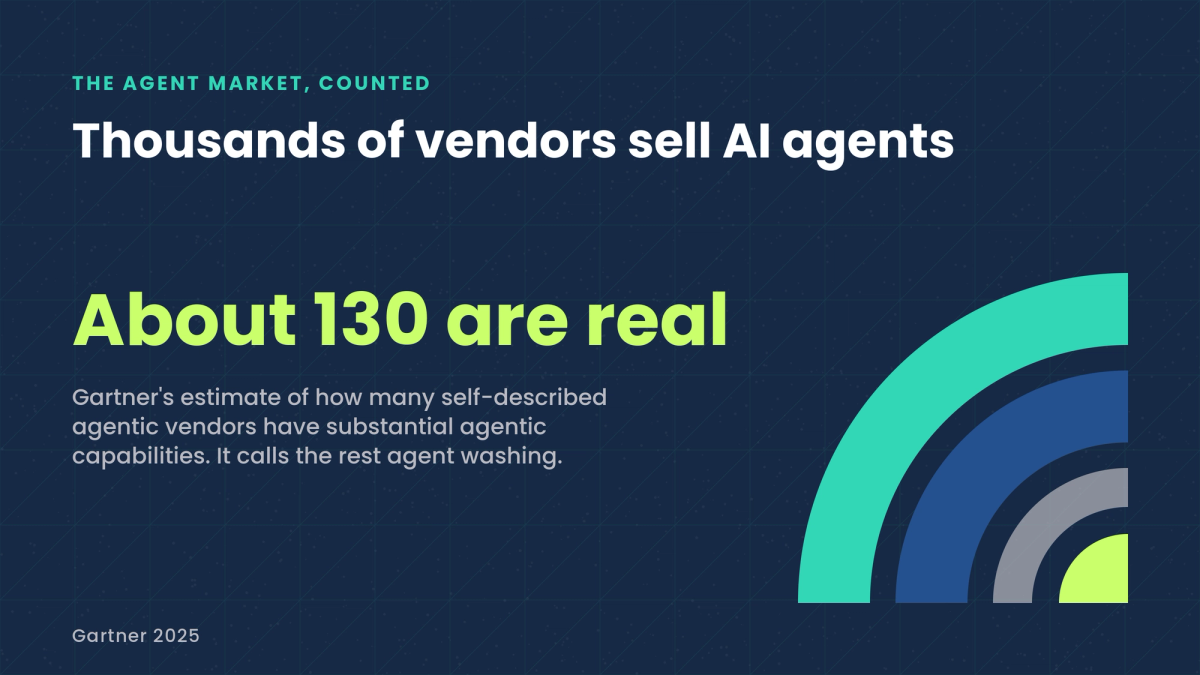
In June 2025, Gartner published two estimates that anyone evaluating post-sales software this year should know. More than 40 percent of agentic AI projects will be canceled by the end of 2027, on escalating costs, unclear business value and inadequate risk controls. And of the thousands of vendors describing their products as agentic, Gartner estimates only about 130 are real. It gave the rest a name: agent washing, "the rebranding of existing products, such as AI assistants, RPA and chatbots, without substantial agentic capabilities" (Gartner, June 2025, from a January 2025 poll of 3,412 webinar attendees).
A head of customer success shopping for software meets that gap on every vendor page. The screenshots look alike, the language is interchangeable, and the pricing conversation starts before anyone has said what the agent will actually own. Gartner's analyst Anushree Verma added the harder point: "Many use cases positioned as agentic today don't require agentic implementations."
What customer success software with native AI agents actually means
An agent is software that takes an objective and carries the work through to a result. It decides which steps the objective needs, reads the evidence, acts inside the systems where the work lives, and reports what changed. Anthropic's guidance on building agent systems lists what each one has to be given: "an objective, an output format, guidance on the tools and sources to use, and clear task boundaries" (Anthropic, June 2025).
In customer success software with native AI agents, the agents are the working layer of the product itself. Each one holds its own context on the accounts it covers, has its own tools to act with, and keeps its own memory of what it has done and how it turned out. A chat window added to an existing platform gives a person a faster way to ask questions of the data, and the person still carries every answer to the next step themselves.
The distinction decides how much work the software can take off the team. An assistant speeds up individual tasks for the person operating it. An agent removes entire workflows from the team's plate, across every account at once, which is what proactive customer account management across a full book actually requires.
How wide the gap is between agent claims and agent practice
The claims are everywhere and the practice is thin. McKinsey's global survey of 1,993 organizations across 105 countries, fielded in mid-2025, found that 88 percent use AI in at least one function, while only 23 percent are scaling an agentic system anywhere in the business, and in any given function no more than 10 percent report scaling AI agents (McKinsey, The state of AI in 2025, November 2025).
Activity, meanwhile, is exploding. Active agents in the Microsoft 365 ecosystem grew 15x year over year, and 18x in large enterprises (Microsoft 2026 Work Trend Index, May 2026). At the same time, only 18 percent of organizations maintain a current and complete inventory of the agents they already have, a figure from IBM's own Institute for Business Value research. More agents arrive every month, few organizations can list the ones they have, and very few are scaling any of them inside a given function.
Post-sales follows the same shape. ChurnZero's 2025 Customer Revenue Leadership Study, a vendor-sponsored survey in which 793 senior leaders reported on their own use, found AI concentrated in call summarization at 73 percent while journey orchestration sits at 11 percent. And in a review run for this piece in August 2026, three of the five major customer success vendors checked had no published page describing an agent capability at all.
The retention number nobody can show you
The strongest evidence in the category is the evidence that is missing. Searching the published material of Gainsight, ChurnZero, Vitally, Planhat, Totango, Catalyst, Sierra, Intercom and Zendesk turns up no named post-sales agent deployment with a verifiable retention, net revenue retention or churn outcome. Every quantified agent case study in the category traces back to support ticket deflection, which is a different job with different economics. Impressive retention figures do circulate, but only on anonymous blogs describing unnamed companies, with no customer, no timeframe and no methodology attached.
That absence sets the honest baseline for any purchase decision made this year. In post-sales, agent orchestration is a capability story with a clear mechanism behind it, and the outcome data has not been published yet, by anyone. A vendor who claims otherwise should be asked for the customer's name.
Five questions that separate a native agent from a rebranded assistant
The practical protection against agent washing is a short list of questions that a real agent architecture can answer specifically and a rebranded assistant cannot.
- What piece of work does the agent own, end to end? A real answer names a workflow and its finish line: renewal preparation across a book, delivered as a ranked list with the evidence attached. An answer that describes better summaries or faster search is describing an assistant.
- What context does it hold? Ask where the agent reads from, and whether each agent carries its own memory and its own view of the accounts it works. An agent that starts every task from a blank page will repeat its mistakes and ask its questions twice.
- Where can it act? An agent finishes work inside the systems the work lives in: the CRM record updated, the message drafted and sent, the report built. If every output lands in a text box for a person to carry the rest of the way, the product is an assistant.
- When does it stop and ask a person? OpenAI's guidance names the two triggers that should route an action to a human: exceeding failure thresholds, and high-risk, sensitive or irreversible actions. A vendor should be able to say exactly where those gates sit. Forrester adds the ownership rule: every agent gets "a named owner who manages its lifecycle — no unowned autonomy" (Forrester, June 2026).
- How is the work measured? McKinsey's headline metric for agents is task success rate end to end, the "percentage of workflows completed correctly without escalation or human intervention," paired with its operating rule that "there can be no 'launch and leave'" (McKinsey, September 2025). A vendor with a real agent can show that measurement loop running.
How Trig answers those questions
Trig is built as the thing those questions describe. You set the goal, and Trig plans the work, builds a team of specialist agents to carry it out, and learns from the results. Each agent is a specialist with its own expertise and its own tools, and for bigger projects the specialists hand off tasks to each other until the job is done, working directly from and acting across the CRM, email, calendar, support and the rest of the stack.
The context question is answered by the Trig Context Engine, which unifies CRM, product, support and billing data into a single living profile of every account and deal, so each specialist holds the slice of an account's reality its work needs. The escalation question is answered at the architecture level, because Trig cannot access data, invoke tools, or take action without explicit approval, and it requests specific information about specific accounts, so the system provides exactly what has been asked for. The measurement question is built into how the product runs: Trig measures whether each action hit its goal, learns what worked and what didn't, and applies that to the each subsequent run.
What this means for a team choosing software this year
The mechanism behind agent teams in post-sales is real and well documented, and the published outcome data is still to come, from every vendor in the category. That combination points to a particular way of buying. Trust the architecture you can verify over the case study you cannot, ask the five questions of every vendor in the evaluation, and hold this one to the same standard.
A team that buys this way will filter out most of what Gartner expects to be canceled by 2027, because agent washing survives on questions nobody asks. The vendors left standing will be the ones who can say what their agents own, what they hold, where they act, when they stop, and how their work is measured.