

How can a customer success leader start using AI in their team?
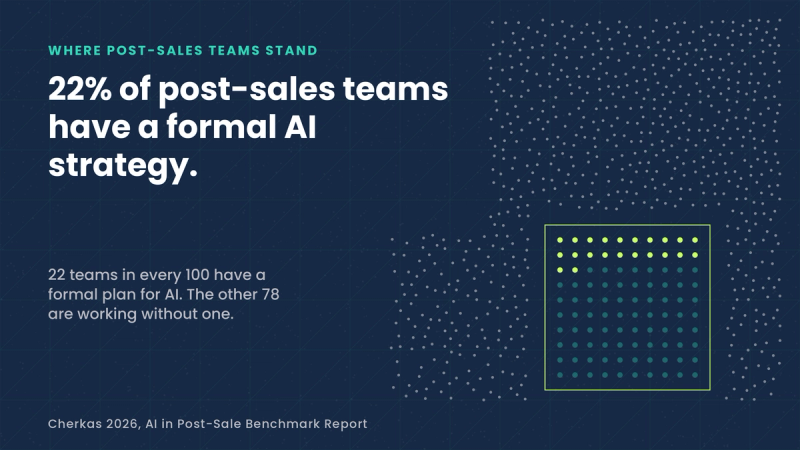
Only 22% of post-sales teams have a formal AI strategy, according to Rod Cherkas's AI in Post-Sale Benchmark Report (191 respondents, March 2026). The rest are spread across the earlier stages: roughly a quarter experimenting informally, close to half piloting specific use cases, and a small minority with AI embedded in how the team works. The pressure to do something is well ahead of the plan.
That gap between pressure and plan is the situation most heads of customer success are in this quarter. The board wants to know what AI is doing for retention. The team has a few people using a meeting summarizer and someone who tried a churn model in a spreadsheet. Nobody has written down which work should be handed to AI first, what success would look like, or when the decision to widen the rollout gets made.
The published evidence is more useful here than the volume of vendor content suggests, because it converges on an order. A leader who wants to start well does three things: hands AI work in a particular sequence, decides the pass or fail measure before the pilot starts, and puts the time the first stage saves somewhere the CFO can see it. Before any of that, though, there is a decision about where the AI comes from.
Should you build or buy AI for customer success?
The first decision is usually settled faster than teams expect. Menlo Ventures' State of Generative AI in the Enterprise (December 2025) found that the enterprise mix flipped from roughly 47% built and 53% bought in 2024 to about 24% built and 76% bought in 2025. Menlo is a venture investor with an interest in the answer, so it helps that MIT's Project NANDA reached the same place from a different direction in July 2025: tools purchased from outside reached deployment about 67% of the time, against about 33% for internal builds.
Buying still leaves the question of which tool. Gartner's October 2025 survey found that 45% of martech leaders say the vendor-offered AI agents they already have fail to meet the business performance they were promised. The useful reading of that number is that any vendor, Trig included, should be judged on what a pilot measures. Running that pilot so the measurement exists is what the rest of this piece covers, starting with which work to hand over first.
What to hand to AI first
Across Gartner's guidance, Cherkas's benchmark and the practitioner accounts collected during research, the same order shows up, and it runs from the lowest-risk work to the highest.
The first stage is internal productivity: meeting summaries, preparation for quarterly business reviews, call prep, account research before a renewal conversation. The risk is low because a person reads everything before it goes anywhere, and the time savings are felt inside the first week.
The second stage is insight and analysis: churn-risk flags, sentiment on recent conversations, renewal and expansion signals across the whole book. Across the same sources, this is the stage leaders rate as having the highest potential, and the one where what teams have done lags furthest behind what they say they intend. The lag has a practical cause. Insight across every account depends on data from several systems being joined correctly, and TSIA's State of Customer Success 2026 names fragmented systems as the biggest barrier to a unified view of the customer, so this stage often waits on plumbing that the first stage did not need.
The third stage is customer-facing and autonomous action: outreach a person did not write, follow-ups that run on their own, digital motions for the accounts nobody had time to cover. This stage comes last, and it is gated on the evidence from the first two. A team that has watched the risk flags be right for two months has grounds to let the system draft the outreach on the next one.
There is a warning attached to the first stage, and it is the one most teams miss. Cherkas found that productivity gains on their own rarely justify the investment, because time saved is, in his phrase, invisible to executives. The amount of time at stake is large: Bain's practitioner survey (235 respondents, August 2025) found about 65% of a customer success manager's time goes to lower-value work that could be automated. But the same survey found net revenue retention declined even as companies hired more customer success roles, which shows that extra capacity does nothing for retention until it is pointed at the accounts that were not getting attention. A leader who gets time back for the team has to decide, in advance, which accounts that time now goes to, and which number on the CFO's dashboard it is expected to improve.
How to run the pilot so it survives
The practitioner convention for the pilot itself is a 30, 60 and 90-day set of decision gates with the go or no-go measures written down before any work starts, and baselined against numbers the team has measured. That convention has no academic validation behind it, and it is worth saying so, but it is what the teams that have got through the pilot stage describe doing. The shape is consistent: pick one workflow that hurts and that ties to revenue or capacity, involve finance early so the measure is one they recognize, and state the result in the terms an executive uses.
The reason to be this deliberate is that the failure data points at organizational causes. Gartner predicts that more than 40% of agentic AI projects will be canceled by the end of 2027, and names cost, unclear value and weak risk controls as the reasons. S&P Global found 42% of companies abandoning most of their AI initiatives in 2025, up from 17% a year earlier. Those two figures come from different populations and measure different things, so they should not be added together, but they agree on where the failures come from.
Deloitte's State of AI in the Enterprise 2026 (3,235 respondents) shows what those causes look like inside a company: only 16% of organizations said their business processes were prepared for agentic adoption, and only 37% had invested significantly in change management, incentives or training alongside the AI itself. BCG's rule of thumb says where the effort should go: 10% on the algorithms, 20% on technology and data, and 70% on people and process. McKinsey's State of AI 2025 confirms the payoff from getting that split right, finding that redesigning the workflow around the AI is the single strongest predictor of AI showing up in earnings, with the high performers 2.8 times more likely to have done it.
The measure also has to include quality, and the clearest lesson on that comes from outside customer success. Klarna cut its headcount from 5,500 to 3,400, said its AI was doing the work of 700 agents, and then in May 2025 reversed course and started hiring people again, because resolution rate and handle time had looked healthy while quality on the harder conversations had decayed (reported by CX Dive and Forbes). A pilot measured only on volume can pass every gate and still be failing.
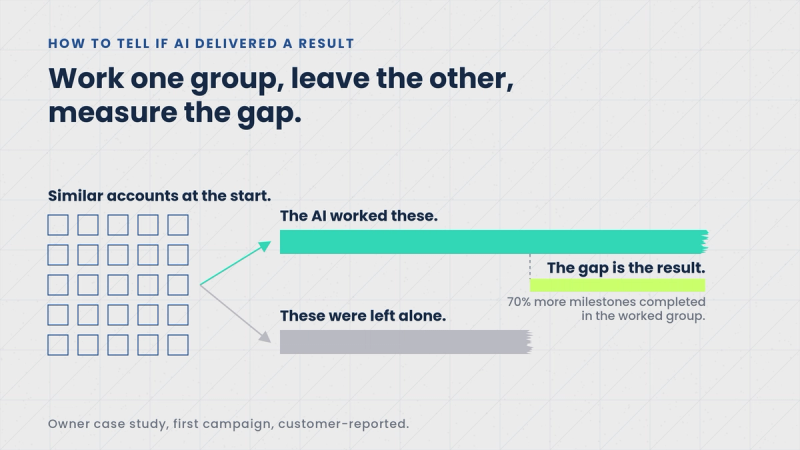
The pilot also has to produce its own evidence, because there is none to borrow. No independently audited case yet exists of AI causally lifting net or gross revenue retention at a company or market level; every retention number in circulation is vendor-reported. The only way for a pilot to show it worked is to compare the accounts the AI touched against similar accounts it did not, and that comparison has to be designed in from the first day.
What Trig does about the rollout
Trig's pieces map onto this order. Revenue Signals and Ask Trig are the insight stage: Trig monitors every account for changes in behavior, ranks each risk and opportunity by revenue impact, and answers questions about the customer base in plain language, with a person reviewing what it finds. Nothing goes to a customer at this stage. A head of customer success can run the first month on Signals alone and judge whether the flags are right before anything else is switched on.
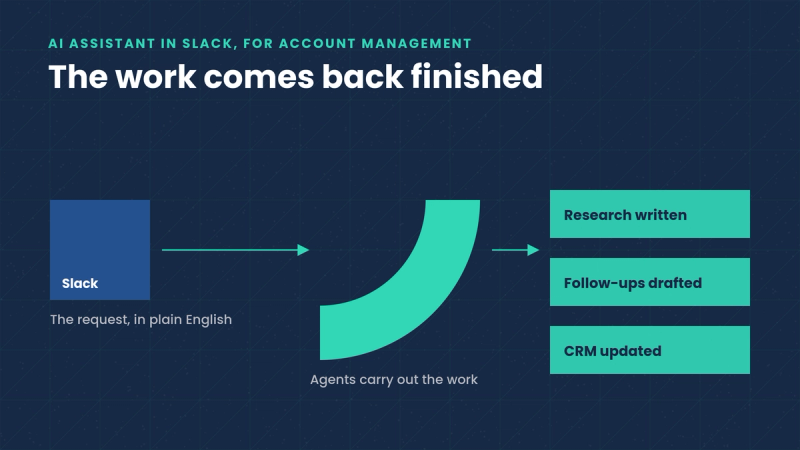
The action stage runs on AI Agents and Jobs. A Job is the unit of work an agent runs: the goal, the target accounts, how long it runs, and which tools it may use, such as email, Slack or the CRM. The team approves each Job before it runs, sets what agents may and may not do, and can pause or stop them at any time. That is the approval gate the sequence calls for, and it is how autonomy gets widened on evidence. A Job that re-engages stalled onboarding accounts gets approved first, and the outreach that follows a risk flag gets approved once the flags have earned it.
The measurement problem is where the fit matters most. Trig tracks how many customers entered a Job, how many completed it and how long it took, and estimates uplift by comparing the customers a Job targeted against similar customers who were not targeted. Those results feed back in as new Signals. That is the control comparison the research says nobody has published, built into the pilot from the first day. On timing, most customers have their first Signals and agents running within a few weeks, and measurable impact from agent actions typically becomes clear within 30 to 60 days as Jobs complete their first cycles, which lands inside the 30/60/90 gates the pilot convention describes.
Consider a team of eight customer success managers covering nine hundred accounts, of which perhaps two hundred get regular attention. In month one, Signals flag the accounts whose usage dropped ahead of renewal, and the managers check the flags against what they know. In month two, the team approves a Job that reaches the flagged accounts among the seven hundred nobody was covering, with the message drafted by the agent and the escalations routed to a named manager. At the 90-day gate, the comparison between touched and untouched accounts is already sitting in the system, in the terms finance asked for at the start.
What this means for the team
A customer success leader who starts this way is answering the board's question with a plan. The first stage gives the team back time and gives the leader a decision about where that time goes. The second stage tests whether the system reads the book correctly before it is allowed to speak to anyone in it. The third stage extends the team's reach to the accounts that were never going to get a person, behind a gate the team controls, with the evidence of whether it worked produced as the work happens. The order is what turns a pilot that stalls into one that renews.
If you’d like to learn more about how to assess your post-sales team’s AI readiness, you can book time with our team here.