
Turn customer intelligence into action.
A system that connects customer history, behavior, and outcomes to inform what agents do next.


Give agents the full customer picture.
Data, conversations, and past agent work form a living profile of each customer’s priorities, history, and commitments.
Combine CRM, product, support, and billing data into one profile that updates as new information arrives.
Retain transcripts, emails, notes, and support conversations so agents understand why customers bought, their priorities, and how they feel about your product.
Remember what agents prepared or delivered, what was promised, and which commitments remain open.



Define success from your customer’s perspective.
Measure customer activity against your milestones to see who is progressing and who is falling behind.
Journey stages
Model phases such as onboarding, adoption, renewal, and expansion around the way your customers use the product.
Customer milestones
Set the outcomes that matter within a stage, such as completing setup or adopting a key workflow.
Evidence of progress
Choose the activity that shows a milestone is being reached, such as inviting a second team or using a feature each week.
Never miss a risk or opportunity again.
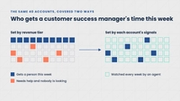
Customer behavior is compared with benchmarks to detect Signals and rank them by potential revenue impact.
Identify slow onboarding, declining adoption, or falling usage before renewal, with the affected account and revenue at risk.
Recognize expansion potential when customers approach seat limits, explore premium features, or bring in more team members.
See which Signals carry the greatest potential revenue impact, so your team can focus its attention.
Learn from every customer outcome.
The system checks each task against its goal and uses what it learns to inform every future interaction.
- Response tracking
Compare subsequent customer activity with the intervention’s objective to see whether the intended progress followed.
- Outcome measurement
Connect the account’s journey and interventions with its eventual renewal, expansion, contraction, or churn.
- Applied learning
Use the history of successful and unsuccessful responses to inform how agents approach similar customer needs.

“Trig transformed our onboarding velocity, significantly reduced our time to value, and materially drove ARR growth. Lots of software tools are useful, but few impact our bottom line like Trig. It’s an incredible product.”
Frequently asked questions.
What is the Trig Context Engine?
The Context Engine is the part of Trig that understands your customers. It brings CRM, product, support, and billing data together with conversations and past agent work in one profile for each account. Agents use that profile to do the right work for each customer.
Does Trig use health scores?
No. Trig tracks each account’s progress against journey stages and compares it with similar accounts. Behaviors are linked to real renewal outcomes, so you can see which patterns predict revenue and which accounts are ahead or behind.
What are Signals?
Signals are the risks and opportunities Trig finds in your accounts. Risk Signals include slow onboarding, declining adoption, or falling usage before renewal. Opportunity Signals include accounts nearing seat limits or trying premium features. Each Signal is ranked by its potential revenue impact.
Can we define what success looks like for our customers?
Yes. You set the journey stages, such as onboarding, adoption, and renewal, and the milestones within each one. You also choose the activity that shows a milestone is being reached, such as inviting a second team or using a feature every week.
Does Trig remember past conversations and commitments?
Yes. Trig keeps transcripts, emails, notes, and support conversations, along with what agents prepared, delivered, and promised. Agents can see why a customer bought, what matters to them, and which commitments are still open.
How does Trig measure impact?
Trig compares customer activity after an assignment with the assignment’s goal, and compares the accounts it worked on with similar accounts it didn’t work on. Results are linked to renewals, expansions, and churn, and they inform how agents handle similar situations next time.
Fully integrated, deeply connected.
Connect Trig to all the tools your team already uses to support existing processes and enable new ones.