
How should B2B SaaS teams use AI for proactive account management?
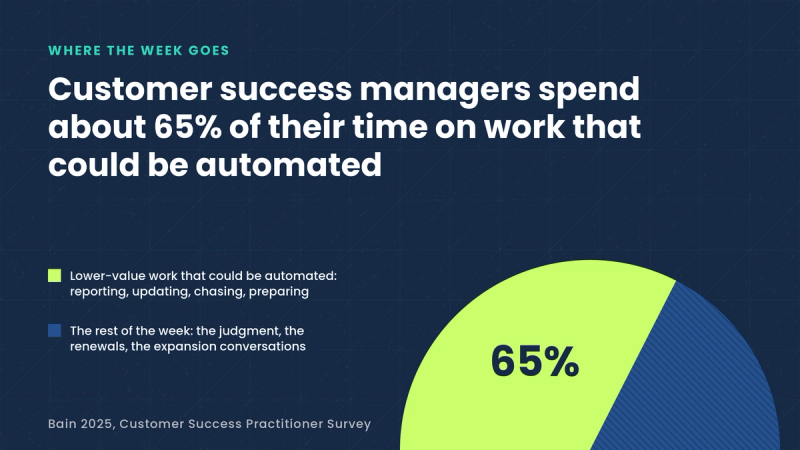
Bain's report on cross-system work in software, published on September 29, 2026, estimates that 30 to 40% of sales work could be automated, and says the rest is held back by "relationship nuance" and "deal-by-deal variation." In the same report, Bain names the largest open opportunity as coordination work that runs across the CRM, billing and support. Those are the systems an account manager reads before every renewal call and every expansion conversation.
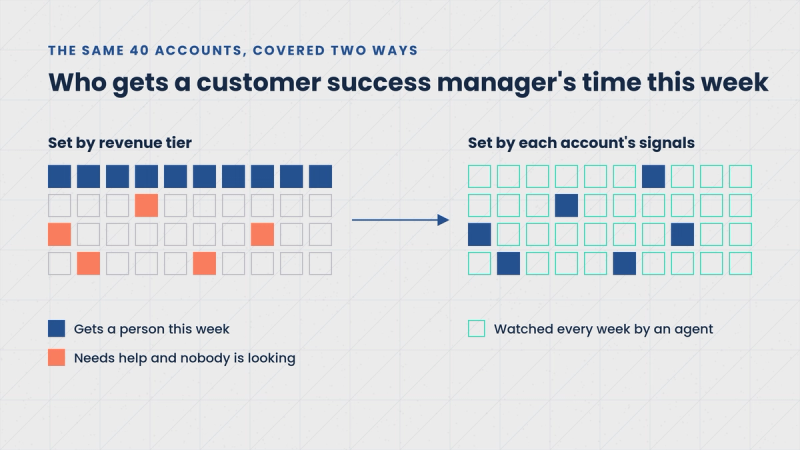
Most account managers know where that reading goes. Before a renewal call, someone opens the CRM for the contract date and the last call notes, checks the product dashboard to see whether usage has held up, searches the help desk for open tickets, and asks finance whether the last invoice was paid. Across a book of sixty accounts, most of the work of being proactive is the work of assembling that picture. The twenty largest accounts get that attention every week, and the other forty are noticed when they ask for something or go quiet.
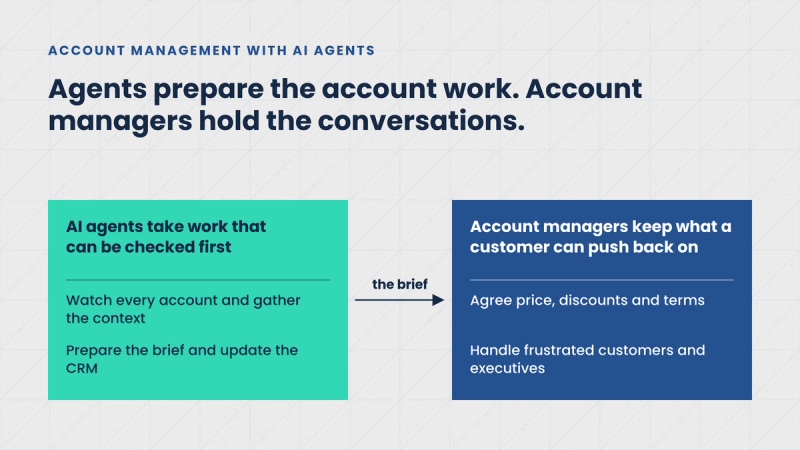
The way to use AI for proactive account management is to divide the work by what each task needs. Agents should take the work that is high in volume, can be checked against the data, and runs across several systems: watching every account for changes, gathering the context behind each change, preparing briefs before conversations and keeping records current. Account managers should keep the conversations where the relationship or the money is at stake, which means pricing and contract terms, customers who are frustrated, and executive relationships. The independent evidence on where agents fall short points at those moments.
Which account management work suits AI agents?
Bain sets out six factors that decide how much of a piece of work an agent can take on: whether the output can be verified, how bad a failure would be, whether the knowledge the work depends on is written down, how many systems and handoffs are involved, how many exceptions the process has, and whether someone has to be physically present. Bain describes missing context, such as exception rules nobody wrote down or a long-serving colleague's preferences, as "almost always the binding constraint." Read against those factors, four kinds of account management work suit an agent well.
- Watching every account. Checking each account's usage, support history, billing status and renewal date every week is a large volume of work, and whether it was done correctly can be checked against the source systems. It is also the first work to stop when a team is stretched, which is why accounts outside the top tier tend to be noticed late.
- Assembling the context behind a change. When usage falls at an account, the explanation is usually spread across the CRM, product data, the help desk and billing. Pulling those together is cross-system coordination work, a category Bain sizes at about $100 billion in the US, with more than 90% of it not yet captured.
- Preparing for the conversation. A brief that sets out the account's recent activity, open tickets, contract terms and the notes from the last call can be checked line by line before the account manager picks up the phone. A mistake in it is caught by the account manager before it reaches the customer.
- Keeping records current. Updating the CRM after a change, creating the follow-up task and recording what was agreed has few exceptions and is easy to verify. It is also the work most often left until the end of the week.
Workers asked about their own jobs lean the same way. Stanford's WORKBank study (arXiv 2506.06576) asked 1,500 workers across 104 occupations, technical sales representatives among them, to rate 844 tasks. Workers were positive about automating 46.1% of the tasks, and the most common reason, given by 69%, was freeing up time for higher-value work. The tasks where workers wanted to keep full control were defined mainly by interpersonal communication, and that is where the evidence against handing work to agents is strongest.
The evidence has one gap that matters here. No independent study has measured how customer success managers, account managers or renewals managers spend their time, and none of the large studies of AI exposure treats these roles as an occupation. The nearest proxies are sales representatives and customer service representatives, so the split above is an inference from those roles and from the shape of the work.
Where do AI agents fall short with customers?
The research on what should stay with people is more specific than the research on what agents should take, and it gathers around three kinds of moment that every account manager will recognize.
Messages that carry the relationship
In a study of 1,100 professionals published in the International Journal of Business Communication in 2025, Coman and Cardon found that when a message had been written with heavy AI assistance, only 40 to 52% of readers saw the sender as sincere, compared with 83% when the assistance was light. The authors recommend using AI for routine and informational messages and keeping it to a minimum where the message is about empathy or praise. For an account manager, the note to a customer after a bad quarter, or to a champion who has just been promoted, belongs in the second group.
Price, discounts and terms
Agents can be talked into concessions. In Project Vend, an experiment in which an Anthropic AI agent ran a small shop, staff persuaded the agent to hand out numerous discount codes. Adding a supervising agent cut discounts by about 80%, yet the supervisor still approved lenient requests about eight times as often as it turned them down. Microsoft's Magentic Marketplace experiment (November 2025) found that negotiating agents accepted the first offer they received between 60 and 100% of the time. Both experiments were run by AI developers on their own systems, and both lead to the same practical rule: renewal pricing and the authority to discount should stay with people.
The renewal conversation itself
The only field experiment found on AI in a renewal comes from consumer lending. Luo and colleagues, writing in Marketing Science in 2019, studied outbound loan-renewal calls to 6,255 customers. When customers did not know they were talking to a bot, it converted about as well as a proficient human, 23.7% against 25.1%. When the bot was disclosed at the start of the call, purchases fell by 79.7%. The study is old and comes from a different market, and a reputable company tells its customers when they are dealing with software. What the result shows is that customers respond to who is on the other end of a renewal. B2B buyers say something similar about advice: in a Gartner survey of 645 B2B buyers (May 2026), 69% said they prefer to validate AI-generated insights with a sales rep.
Taken together, these findings mark out the work account managers should keep: setting price and terms, handling a customer who is frustrated, writing the messages that carry the relationship, and owning the relationship with the customer's executives. The work that prepares for those moments is the work an agent can take on.
What should AI tools for proactive account management actually do?
A tool built around that division has to do four things well, and each one can be checked in a trial.
- Read across the systems where the account's story lives. A fall in usage should arrive with the open tickets, the overdue invoice and the last call notes attached, because Bain found that missing context is what most often limits an agent, and a tool that reads only the CRM sees a fraction of the account.
- Watch every account on a schedule. A health score or an expansion signal helps only when someone sees it change, so the accounts nobody has opened this quarter need checking as often as the largest ones.
- Prepare work for a named person. The output of most proactive work is a brief, a report or an updated record, delivered to the account manager in the place they already work.
- Let the team decide which actions need a person. Anything touching price, terms or an unhappy customer should go to the account manager, while routine updates and check-ins run on their own.
A practical test when trialing any tool is to ask what happens when a customer replies to an agent's email asking for a discount. A tool that fits this division hands that reply to the account manager, together with the context needed to answer it.
How Trig divides the work
Trig is designed around this division. Each account gets the work its situation calls for, carried out by an agent, with the result delivered to the person who owns the relationship.
The Trig Context Engine, the part of Trig that holds what it knows about each customer, joins data from the CRM, product analytics, support and billing into a single profile of every account. Signals, which are Trig's alerts for changes in an account's behavior, watch those profiles across the whole customer base. A falling usage trend or a run of escalated tickets is picked up whether or not the account is in anyone's top twenty.
Work in Trig runs as Jobs. A Job is a defined piece of work for an agent: the goal, the accounts it applies to, how long it runs, and the tools it may use, such as email, Slack or the CRM. Trig works inside the systems a team already has, so an email goes out through the company's own email service provider and a task is created in the CRM. The team approves a Job before it runs, sets guardrails on what agents can and cannot do, and can pause or stop any Job at any time. Human approval is built into the decisions where judgment is needed, so the account manager's attention goes to pricing, terms and the customers who need a person.
What this looks like in practice
Consider a team of five account managers covering six hundred accounts, with seventy renewing next quarter. Each manager gives close attention to about twenty accounts and checks the rest when something comes up.
With the work divided, a Signal picks out the renewing accounts whose usage has fallen over the last sixty days, and eleven of the seventy are flagged. A Job prepares a brief for each of the eleven and sends it to the account owner in Slack, covering the usage trend, the two support tickets escalated last month, an invoice thirty days overdue, the contract terms and the notes from the last call. A second Job creates the renewal task in the CRM and records the next step. For the healthy accounts in the long tail, a third Job sends a check-in email through the company's email provider, with guardrails that keep pricing out of the agent's hands and hand any account with an open escalation to its owner.
The account managers spend the week on the eleven calls. One customer is frustrated about an outage and gets a call from their account manager the same day. Another asks for a discount, and the account manager agrees the terms with their own manager. Agents prepared every one of those conversations, and people held each of them.
What this means for the team
Proactive account management has been limited by how many accounts a person can read before the week runs out. When agents check every account, gather the context and keep the records up to date, every account gets attention on a schedule. The account manager's time then goes to the conversations where a person's judgment shapes whether the customer renews or grows, such as agreeing the price, calming a frustrated customer or meeting the executive who signs. The decision that matters is made one task at a time, by asking which side of that line each piece of work belongs on.