
How should customer success teams cover tech-touch and scaled customer segments?
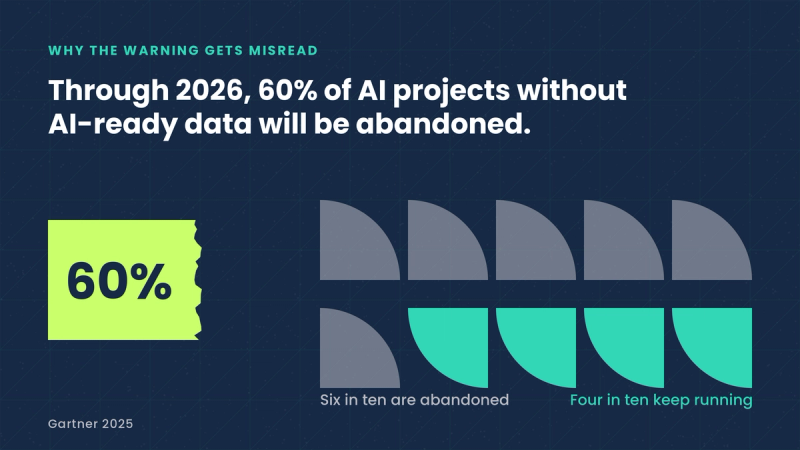
The Customer Success Collective's State of Customer Success 2026 survey found that 37% of customer success teams decide coverage by revenue, and another 37% have no formal capacity model at all. Only 5.5% prioritize accounts by risk or adoption. The survey does not state its sample size, so the exact figures deserve some caution, but the pattern will be familiar to anyone who has run a customer success team.
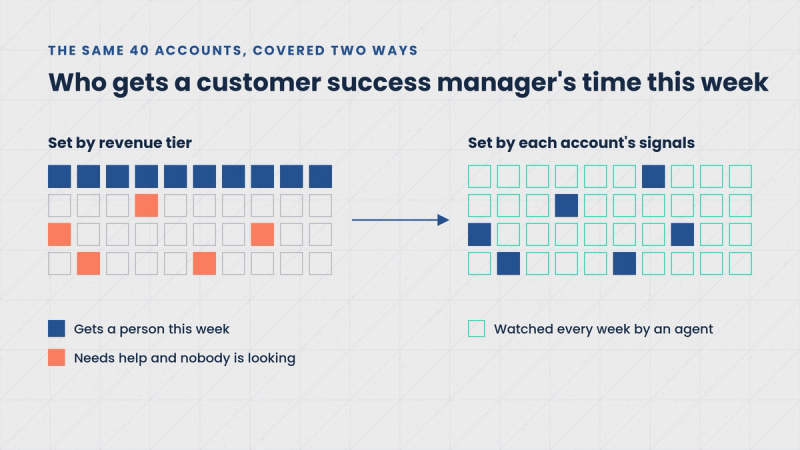
At the top of the book, each large account has a named customer success manager. The middle shares one. Everything below a revenue line goes into tech touch: an onboarding email sequence, a quarterly newsletter, a webinar invitation and a support queue. An account in that bottom tier can stop logging in for six weeks, and nobody on the team finds out until the renewal notice goes out or the cancellation arrives. Meanwhile a large account that is healthy and growing still gets its weekly call, because its tier says it should.
The tier was set by what the customer pays, and the attention an account needs depends on what is happening inside it. Revenue and need line up for some accounts. When they don't, the team spends its hours on the accounts the org chart points to and misses the ones the data points to.
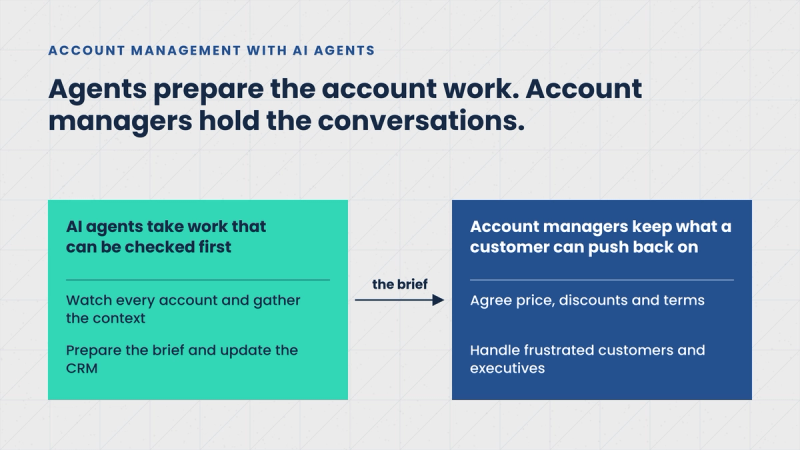
The way to cover tech-touch and scaled segments with AI is to group accounts by their state: onboarding that has stalled, usage that has fallen, a renewal coming up with open tickets, or signs that a customer is ready to buy more. Agents watch every account, whatever it pays, and the state an account is in decides what work is done for it. People are assigned where a state calls for judgment, which will include some small accounts and will leave some large, healthy ones on routine work for a quarter. Revenue still decides how much of a person's time an account is worth, and the account's state decides when that time is spent.
Why tech-touch tiers are drawn by revenue
Revenue tiers made sense when the only way to cover an account was a person's attention. A customer success manager can know thirty or forty accounts well, so teams gave their people to the accounts that paid the most and sent automated email to the rest. The tech-touch tier is a capacity decision written into the org chart.
The same report also records where some practitioners think coverage is heading. Raymond Otero, quoted in the Customer Success Collective's report, describes the future of capacity planning as "signal-based segmentation," where accounts are grouped by what their data shows about them.
TSIA's State of Customer Success 2026 (February 2026) takes the same direction from a different angle. It describes AI shifting from "a tool that helps you automate tasks" to "the operating fabric of CS," and it expects digital customer success to cover the whole book, including enterprise accounts, where today it usually covers one segment. Under that view, the digital motion runs across every account, and the person is added where the account needs one.
What happens when AI is added to a revenue-tiered book
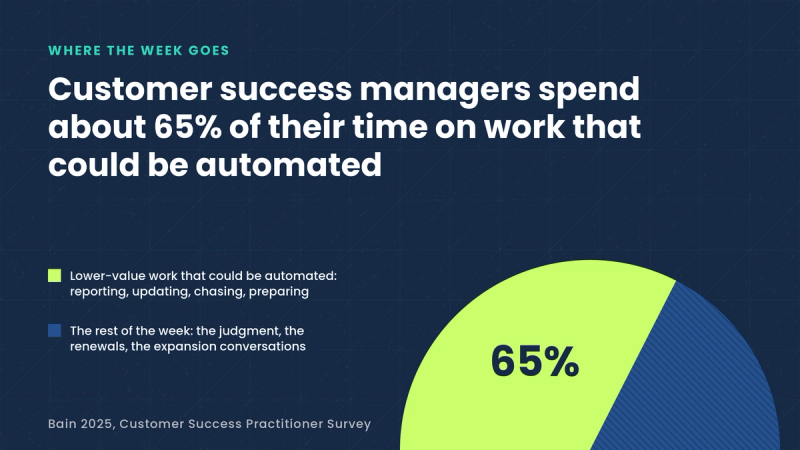
Most teams start by adding AI to the model they already have. An assistant drafts the tech-touch emails faster, and the named managers get meeting summaries and call notes written for them. That saves time, and the open question is where the time goes.
Studies across functions suggest that most of it is absorbed by the work people were already doing. BCG's AI at Work 2026 survey (June 2026, about 12,000 respondents) found that 42% of frontline workers who use AI regularly save a full day a week, but 66% get little or no guidance on what to do with that time, and more than half do not redirect it. Gartner (June 2026) has a name for the assumption that saved time turns into revenue by itself: the "automatic capacity expansion fallacy." In a revenue-tiered team, the day a named manager saves flows back into the same top-tier accounts, and the tech-touch tier keeps getting email.
McKinsey's State of AI 2026 (August 2026, 1,719 respondents across functions) shows the same gap at company level. 80% of respondents say AI has raised their own productivity, yet only 37% report any contribution to EBIT, the same share as in 2025. Nearly three quarters of the companies McKinsey classes as AI high performers have redesigned their workflows, against about a quarter of everyone else. McKinsey describes the high performers as redesigning the work itself, where the others add AI on top of the workflows they already had.
Economic history has a well-known version of this. Paul David's study of electrification (American Economic Review, 1990) found that electric motors drove about half of US factory power by around 1920, yet productivity gains only arrived during the 1920s. The first factories to adopt electricity swapped the steam engine for one large electric motor and kept the old belt-and-shaft layout. The gains came when factories were rebuilt with a motor in every machine. A customer success team that puts AI inside its revenue tiers has installed the large motor and kept the shafts.
How to scale customer success without hiring more CSMs
Reorganizing coverage around account state can start with one workflow. The steps below are the order in which a team can build it.
- Write down the states that matter. Define in data what stalled onboarding, falling usage, renewal risk and expansion readiness look like for your product. A setup milestone not reached by day thirty, logins down by half over sixty days, or a renewal inside ninety days with an escalated ticket are each a state an agent can check.
- Watch every account for those states. This is the step that was too expensive when only people could do it, and it is the step an agent can repeat across thousands of accounts every week. TSIA found that the ability to unify customer data is one of the strongest predictors of renewal performance, and it applies here, because a state like renewal risk needs usage, support and billing read together.
- Attach work to each state. For each state, decide what should be prepared or done and who receives it. A stalled onboarding might produce a progress review for the account owner, a healthy long-tail account might get a check-in email, and expansion readiness might produce a brief for a commercial conversation.
- Decide where a person steps in, by state. A stalled onboarding at a small account can go to whoever covers the pooled segment that week. A frustrated customer goes to a person whatever tier the account sits in.
- Decide where the saved time goes before you start. If the freed hours are pointed at the accounts the states have flagged, the capacity reaches customers. If they are left undirected, BCG's finding suggests most of them will be absorbed by whatever the team was already doing.
A sensible first workflow is renewals due in the next ninety days, because the states are easy to define and the result is easy to check. Once it runs well, the next state can be added.
There is one gap in the evidence that a leader should know about. No independent study yet compares net revenue retention, gross revenue retention or cost to serve for a customer success team reorganized this way against one that added AI to its existing tiers. The case rests on operating logic and on history from other technologies, so a team making the change should record its baseline first and measure the result itself.
How Trig covers every account by its state
Most customer success software is designed around the number of accounts a person can manage, which is why it gives teams dashboards, health scores and workflows and leaves the work itself to the people in each tier. Trig is designed so that coverage follows the account.
The Trig Context Engine, the part of Trig that holds what it knows about each customer, joins data from the CRM, product analytics, the data warehouse, support and billing into a single profile of every account. Signals, which are Trig's reading of an account's state from that profile, run across the whole customer base. Slow onboarding, a pattern that suggests risk or signs of expansion readiness are picked up in an account paying $5,000 a year in the same week as in one paying $500,000.
Work in Trig runs as Jobs. A Job is a defined piece of work for an agent: the goal, the accounts it applies to, how long it runs and the tools it may use, such as email, Slack or the CRM. Because a Job's audience can be defined by a Signal, a Job can apply to every account whose onboarding has stalled, wherever that account sits in the revenue tiers. The team approves a Job before it runs, sets guardrails on what agents can and cannot do, and can pause or stop any Job at any time. Human approval is built into the decisions where judgment is needed, and the results go to the account owner in the tools they already use. When an account's state changes, the Signal changes and the work changes with it.
What this looks like in practice
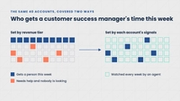
Consider a team of eight customer success managers covering 1,200 accounts. Under revenue tiers, each manager owns twenty named accounts, so 160 accounts get a person and 1,040 are in tech touch.
With coverage organized by state, Signals check all 1,200 accounts each week. In one week they flag 34 accounts with stalled onboarding, 21 of them in the tech-touch tier. They flag 58 accounts with falling usage and a renewal inside ninety days, 40 of them in tech touch, and 12 accounts showing signs of expansion readiness, 5 of them in tech touch. A Job prepares a progress review for each stalled onboarding and sends it to the account owner, or, for tech-touch accounts, to the manager covering the pooled segment that week. A second Job prepares a renewal brief for each of the 58 accounts, with the usage trend, open tickets, billing status and last call notes. A third assembles the context for the 12 expansion conversations for a commercial review.
The eight managers spend that week on the 104 accounts that need a person, and 66 of them would have been in the tech-touch tier under the old model. The large accounts that show none of these states keep their scheduled contact, and the time the team saves on them goes to the flagged accounts by design. The figures here are an example, and every team's states and thresholds will differ.
What this means for the team
For a customer success leader, the change is in what a segment means. In a revenue-tiered team, the segment decides whether a person ever looks at an account. When coverage follows each account's state, every account is watched, and the segment describes how much of a person's time an account is worth once it needs some. The accounts at the bottom of the book are then the ones a team hears about when their onboarding stalls, which is weeks earlier than when they cancel.