AI customer success tools fall into three groups by what the AI actually does, and which group you need matters more than any ranking.
The best AI customer success tools in 2026, and who each one is for

What are the best AI customer success tools in 2026?
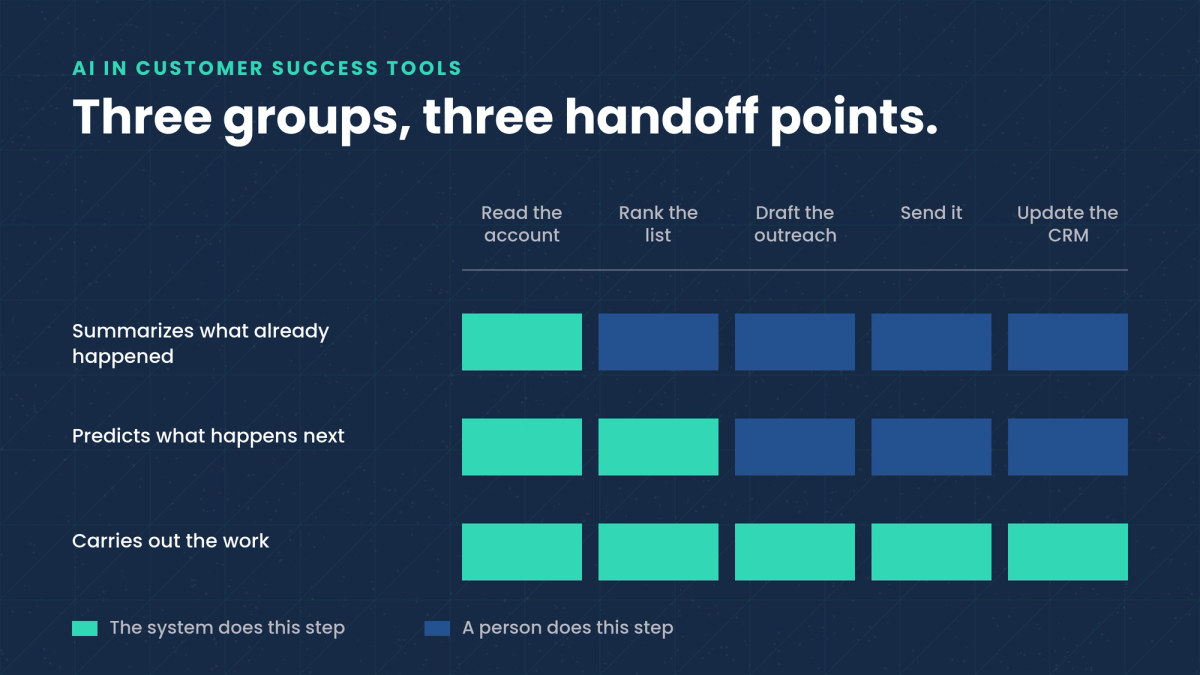
These tools fall into three groups, and working out which group you need matters more than where any one product sits in a ranking. Some of them use AI to summarize what already happened on an account. Some use it to predict what is going to happen next, usually as a score or a ranked list. A smaller number use it to carry out the account work itself: writing the follow-up, sending it, and updating the record in your CRM afterwards. A team of four people looking after eight hundred customers and a team of twelve looking after ninety will both search for this, and they need different things.
Each entry below covers what the product is built around, what its AI actually does, and the kind of team it tends to suit. There is no pricing here and there are no review scores. Both of those change often, both get quoted inconsistently on the pages that publish them, and neither can be stated reliably from outside the company selling the product. What holds still is the shape of the product and the shape of the team using it, so that is what these entries describe.
What the AI in these tools actually does
Some of it summarizes. The product reads call recordings, support tickets and email threads, then writes a short version your team can take in quickly. This is the most widely available kind of AI in the category and the most dependable. It saves reading time, and a person still decides what the summary means and what to do about it.
Some of it predicts. The product scores each customer on how likely they are to leave or to buy more, and hands your team a ranked list. Health scores belong here, and a health score is simply a single number meant to summarize how well a customer is doing. The list still arrives on somebody's desk, and a person still has to work down it.
A little of it acts. The product does the work itself: drafting the message, sending it, logging the activity, and updating the fields in your CRM. Fewer products do this, and it is where the largest amount of work comes off a person's desk.
The difference between the three decides how much of your team's week actually changes. The first two make reading and prioritizing faster, and your team still works through the list at the end of it. The third takes some of that list away.
The tools
Most of the products below are customer success platforms. A customer success platform is a single system that holds everything known about a customer after they have bought: the account record, what they do in the product, when they renew, and the tasks each person on your team owes them. The last few entries are different kinds of product that show up in the same search for good reasons.
Gainsight is a customer success platform built for large post-sales organizations, and nearly everything in it can be configured to match how a particular company already works: how customers are scored, what stages they move through, which tasks fire when, and how all of it gets reported. It has added a line of AI agents over the past two years alongside its summarizing and scoring. That configurability is why large teams choose it, and it is also the thing somebody has to keep current, so it suits companies that have a named person running the system.
ChurnZero is organized around customer health and the standard sequences of work that fire off it, and it can send messages inside your product as well as by email, which lets a small team reach a large number of customers without contacting each one individually. Its AI mostly summarizes calls and assembles account research. It suits a team that has already agreed what its renewal process looks like and wants that process to run on a schedule.
Vitally is organized around a data model you define yourself and the views your team builds on top of it. You decide what to track, connect your product and billing data, and build the boards and dashboards you want over that structure. Teams that enjoy building their own working environment get the most out of it, and teams that want a finished process handed to them find the blank page hard going.
Planhat sets out to be a single system for everything that happens after the sale, covering customer success, account management and professional services over the same customer data. That breadth pays off when those teams genuinely move in and work there. It suits a company consolidating several post-sales tools into one, where the renewal conversation, the expansion plan and the delivery project can all point at the same record.
Totango, which now trades as Odie, was organized around ready-made programs a team could adopt as they came, which shortened setup for teams with no operations support behind them. The company has since relaunched under the Odie name with a product aimed at post-sales teams building their own AI agents. Anyone evaluating it today is looking at a platform partway through a change of direction, which is worth knowing before the first call.
Custify is aimed at business software companies that want customer scoring and automated lifecycle messaging without the administration a large enterprise platform assumes. It suits small and mid-sized customer success teams who need the day-to-day workflow more than they need depth of configuration.
ClientSuccess is organized around what a customer success manager does week to week and what a leader needs to see about renewals, and its setup is lighter than the enterprise systems. It suits a team that wants its process visible to management without hiring somebody to administer the software.
Velaris is built for small customer success teams and puts AI summaries and workflow automation in the same account view. It suits a team that wants the picture of the account and the automation on it in one place.
HubSpot is worth considering when your commercial records already live there, because its customer and service tools keep renewal dates, account owners and outreach in the same system as the rest of your revenue data, and its AI, called Breeze, works on top of those records. It suits a team trying to reduce the number of separate systems it runs, where the customer success process is simple enough to live inside the CRM.
Intercom and Zendesk are support platforms, and they earn a place on this list because their AI is the part of this category with published results behind it. Deflection rates and resolution rates get measured and reported. They cover the questions customers actually ask, and customers who never open a ticket stay outside their view.
Pendo and Amplitude are product analytics tools, which means they measure what customers do inside your product. That is where the earliest sign of a renewal problem usually shows up, as usage falling away before anyone says anything. Both can also show guidance inside the product, which is how a good deal of self-serve onboarding gets delivered. They sit underneath a customer success program and feed it.
Trig is a Revenue AI, which is a different kind of product from the platforms above. It connects directly to your CRM, product analytics, support and billing systems, builds a single profile of every customer out of them, and then puts teams of specialist AI agents to work on the accounts themselves. The agents carry out the work, and your team reviews it. It suits a team that can already see what needs doing and cannot get to all of it.
When the problem is getting the work done
Every product above the support tools shares one assumption, and it is worth naming because it decides whether any of them will help you. The system gathers the information and presents it, and your team then works through what it has presented. Scores, dashboards, task lists and standard sequences are all ways of putting work in front of a person. That assumption holds perfectly well for as long as your team can get through the work it puts in front of them.
Consider a team of five people looking after six hundred customers. Everyone knows what ought to happen on each account. There are more accounts than there are hands, so renewal conversations get skipped, follow-ups slip, and the CRM falls behind. A customer success platform will give that team a much clearer picture of the work. The team still has to do the work.
Trig starts from the other side of that assumption. It is a different model for looking after and growing a customer base, in which you deploy a team of specialist AI agents that carry out the account work themselves: the research on the account, the renewal outreach, the follow-ups, the CRM updates and the pipeline reporting, across every customer, including the ones nobody has had time to reach. The agents work inside the tools your team already uses. Where a decision needs human judgement, a person approves it before anything happens. Setting it up is quick, because Trig learns your company, your products and your customers from the data you already have.
The boundary runs in both directions, and it is worth being honest about. A team that wants a system of record, customer scores it controls, and standard sequences run by an operations person is describing a customer success platform, and one of the products above is the right purchase. A team whose real constraint is getting the work done on every account is describing what Trig was built for.
What to check before you buy
Ask what the AI produces, and who acts on it. The answer is a summary, a ranked list, or finished work, and every demo describes all three in similar language. The difference shows up in the third month, when somebody on your team is either reading output or reviewing work that has already been done.
Name the person who will run the system, and count their time as part of the price. A configurable product rewards a team that keeps it current, and that same configurability is why a system nobody owns quietly goes stale.
Run the trial on your own customers and your own data. Every product demos well on the seller's dataset. Write your renewal process down before the first call, then ask each company to build it in front of you from end to end: the signal that starts it, the task it creates, and the note that lands in your CRM.
What the choice comes down to
Start from your own constraint. A team that cannot see clearly what is happening across its customers is buying a system of record, and most of this list will serve. A team that can see it clearly and cannot get to all of it is buying coverage, which narrows the list quickly, and that is the problem Trig takes on. These products look most alike in the demo and least alike in the third month, and the third month is the one worth thinking about now.