

How do I automate customer renewal management with AI?
TSIA's State of Customer Success 2026 (February 2026) found that the data problem in customer success is access. The information a team needs usually exists somewhere, and AI "only sees fragments" of it. Anthropic's Economic Index (September 2025), which is published by an AI vendor, makes a related point about account work. It uses "develop a sales strategy for a key account" as its own example of a task that needs CRM data "but also tacit knowledge," and it says that scattered context "may be a bottleneck."
A renewal shows both problems at once. Ninety days out, the account owner opens the CRM for the renewal date and contract value, the product analytics tool for logins and seat usage, the support system for open tickets, and the billing system to check that last quarter's invoice was paid. Then they read back through three months of call notes to find what was promised at the last business review. Most of that morning is assembly. The detail that decides how the conversation should go, such as the customer's sponsor going quiet since a reorganization, is often in the owner's head and nowhere else.
That is why "automate renewals with AI" is a harder instruction than it sounds. A renewal is a dozen or so separate tasks. Some of them read data that sits in systems and produce output anyone can check. Others depend on what a person knows about the customer, or commit the company to a price. An agent handed "the renewal" as one job gets both kinds of work and only fragments of the data, and it is likely to do the first kind well and the second kind badly.
The way to automate renewal management with AI is to break the renewal into its tasks and give agents the ones whose context is already in your systems, whose output someone can check, and whose mistakes are cheap to undo. Then connect those tasks into one preparation workflow that runs from the account that needs attention to a renewal brief in the owner's hands. The tasks that depend on what a person knows about the customer, and every decision about price and terms, stay with the person who owns the relationship.
Why AI for renewals often starts with the tool
Most teams meet AI for renewals through a product demo, so the first question they ask is what the tool can do. Ravin Jesuthasan, writing in MIT Sloan Management Review (2025), argues that leaders should "work backward" from the tasks in a job, and he contrasts that with going "tech-forward" from the tools. His method sorts each task into one of three kinds: work to substitute, work to augment and work to transform.
McKinsey reached a similar conclusion from more than 50 agent builds (September 2025). Its summary is that the workflow matters more than the agent. Teams that focus on the agent, McKinsey found, produce "great-looking agents that don't actually end up improving the overall workflow," and some companies have ended up "rehiring people where agents have failed."
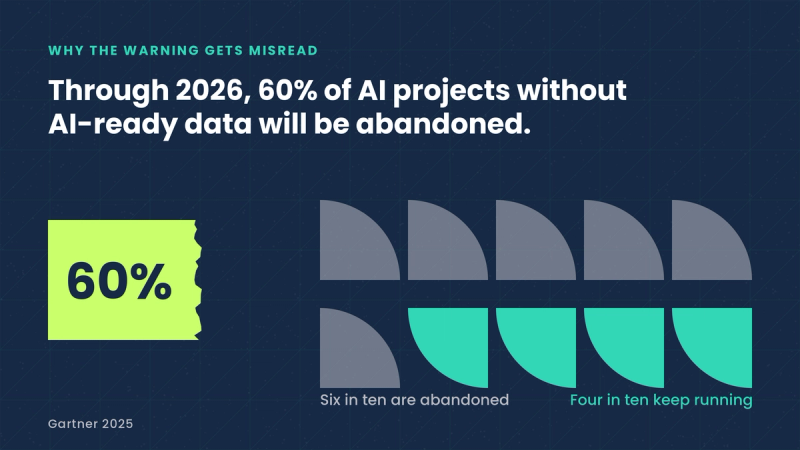
Gartner (June 2025) predicts that more than 40% of agentic AI projects will be canceled by the end of 2027, and says that "many use cases positioned as agentic today don't require agentic implementations." Its guidance is to use agents where decisions are needed, automation for routine workflows and assistants for finding information.
All three sources describe work across functions, and none is specific to renewals. For a renewal team, their shared lesson is that the choice of tool is the second decision. The first is which parts of the renewal a machine should do at all.
How to decide which renewal tasks AI should do
Four questions sort most renewal tasks.
- Where does the context live? If everything a task needs is in the CRM, product analytics, support and billing, an agent can read it. If the task depends on a relationship history that was never written down, it stays with the person who holds that history. TSIA's finding applies here: an agent that can see only one system produces a partial answer, so the systems have to be joined before the task is handed over.
- Can someone check the output? A list of accounts renewing in the next ninety days can be checked against the CRM in a minute, and a call summary can be checked against the call notes. Researchers at Carnegie Mellon and Stanford (October 2025) compared 48 people with four agent frameworks on 16 tasks and found the agents 88% faster at 90 to 96% lower cost, with worse quality. They also found that agents often "mask their deficiencies via data fabrication." That speed is worth having on work where a made-up detail would be caught.
- What does a mistake cost, and can it be undone? A wrong number in a draft brief costs a correction before anyone outside the team sees it. A discount offered to a customer is very hard to take back.
- How much does the task vary? McKinsey's rule for matching a task to a tool is rules-based automation for repetitive work with structured input, generative AI where unstructured input has to be read or written, and agents for multistep decisions with "a long tail of highly variable inputs." For low-variance, standardized work, McKinsey says agents "could add more complexity and uncertainty than value." A reminder sent 120 days before every renewal is a rule. Working out why one account's usage fell last month is a job for an agent.
Before scoring anything, measure the work itself. No independent study has measured how customer success managers, account managers or renewals managers spend their time, and none of the major studies of AI exposure has an occupation for these roles. A team therefore has to measure its own renewal work, and four to six weeks of calendar, email, CRM activity and call data will show where the hours go more reliably than anyone's memory. A short, no-blame survey of the AI tools people already use for renewals adds the candidates the team has found on its own.
Then test the tasks one at a time, because the boundary between what AI does well and badly is hard to predict. In a Harvard Business School and BCG field experiment with 758 consultants (2023), people using AI on a task just outside its capability were 19 points less likely to reach the right answer. On tasks inside it, they completed 12.2% more tasks, 25.1% faster, at more than 40% higher quality, and tasks that looked equally difficult fell on different sides of the line. The study was of consultants, and the lesson for a renewal team is to run each task on a handful of real accounts and check the output before scaling it.
Which renewal tasks to automate with AI
Run those questions over a typical renewal and the tasks fall into three groups. The grouping below is Trig's view, built from the questions above, and every team's details will differ.
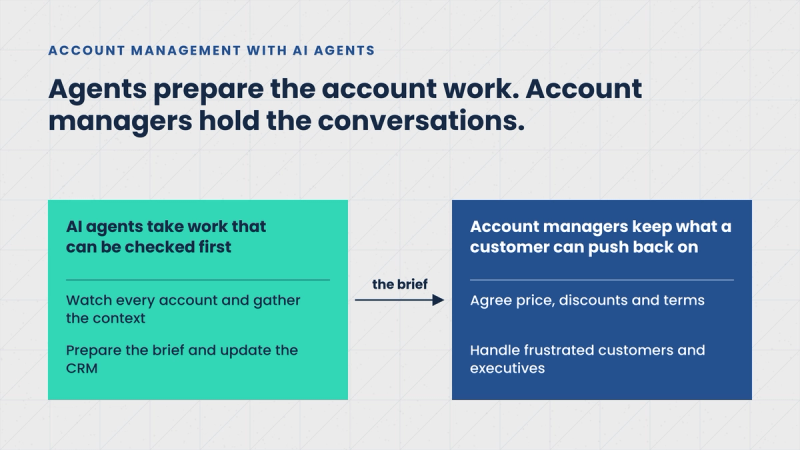
- Agents do the work, and a person reviews the exceptions. This group covers finding the accounts with a renewal in the next 120 days, pulling ninety days of usage against the seats the customer bought, collecting open and recent support tickets, checking billing for overdue invoices, plan and seat count, and keeping the renewal fields in the CRM current. Each task reads data that sits in a system, produces something that can be checked against that system, and is cheap to correct.
- Agents prepare, and a person delivers. This group covers summarizing the last quarter's calls and the commitments still open, flagging that a key contact has stopped replying or left the company, drafting a renewal brief with a read on risk, and drafting the first outreach email. The agent does the assembly. The account owner checks it, adds what only they know and decides what reaches the customer.
- People do the work, and agents supply the context. This group covers deciding price, discount and contract terms, holding the renewal conversation, handling a customer who is frustrated or escalating, and managing the relationship with the executive sponsor. These tasks depend on judgment and on knowledge that is rarely written down, and some of them commit the company to money.
The evidence also points to preparation as the place to start. No independent controlled study has yet tested agents running B2B renewals, expansion or executive business reviews, and every published outcome figure for renewal agents comes from a vendor. Until that changes, the use of agents in renewals that a leader can defend is making sure the person who runs the conversation walks in fully prepared.
Why the whole renewal workflow matters more than any one task
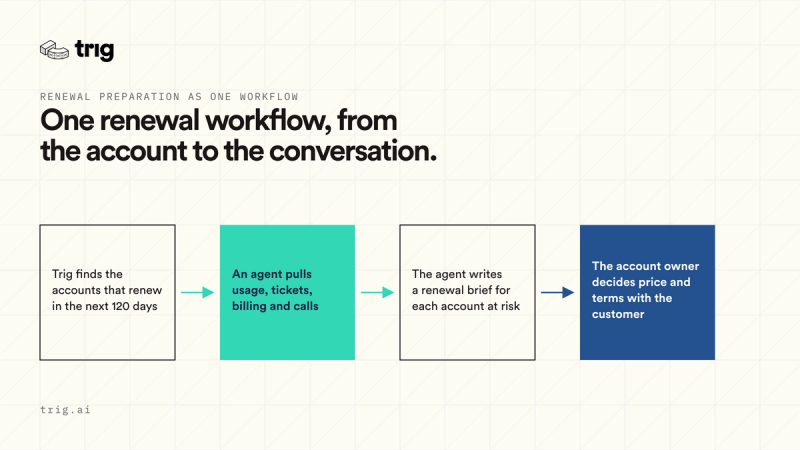
Automating tasks one by one still leaves a person stitching the results together. If one tool pulls usage, another summarizes calls and a third updates the CRM, the account owner still has to notice which accounts need attention, collect three outputs and work out what they mean together. The unit worth handing over is the workflow: renewal preparation, from the condition that starts it, to the brief, to the conversation, with the handoffs between those steps redesigned at the same time.
Before the workflow runs, a team should write down four things. The first is the baseline, such as how long preparing a renewal takes today and how many renewals get a real review ninety days out. The second is the outcome that matters, for example the share of at-risk renewals that get a conversation before day sixty. The third is a date by which the team will either scale the workflow or cancel it. The fourth is which accounts the saved hours will go to.
The signs that a team has picked the wrong work are recognizable. The use case came from a vendor demo, the agent can see only one system, an agent is doing a job a simple rule could do, the time saved has no destination, or nobody owns checking the output.
How Trig automates renewal preparation
Most customer success software gives a renewal team a dashboard of dates and health scores and leaves the preparation to people. Trig is built so that agents carry out that preparation as defined work.
The Trig Context Engine, the part of Trig that holds what it knows about each customer, joins data from the CRM, product analytics, the data warehouse, support and billing into a single profile of every account. That addresses the problem TSIA describes, because an agent preparing a renewal reads usage, tickets, billing and history together. Signals, which are Trig's reading of an account's state from that profile, pick out accounts approaching renewal whose data shows risk.
Work in Trig runs as Jobs. A Job is a defined piece of work for an agent: the goal, the accounts it applies to, how long it runs and the tools it may use, such as email, Slack or the CRM. A Job is what a team ends up with after it runs the four questions on one workflow, because it writes down which tasks agents do and for which accounts. The team approves a Job before it runs, sets guardrails on what agents can and cannot do, and can pause or stop it at any time. Human approval is built into the decisions where judgment is needed, so price, terms and the conversation stay with the account owner, and the brief arrives in the tools the owner already uses.
What this looks like in practice
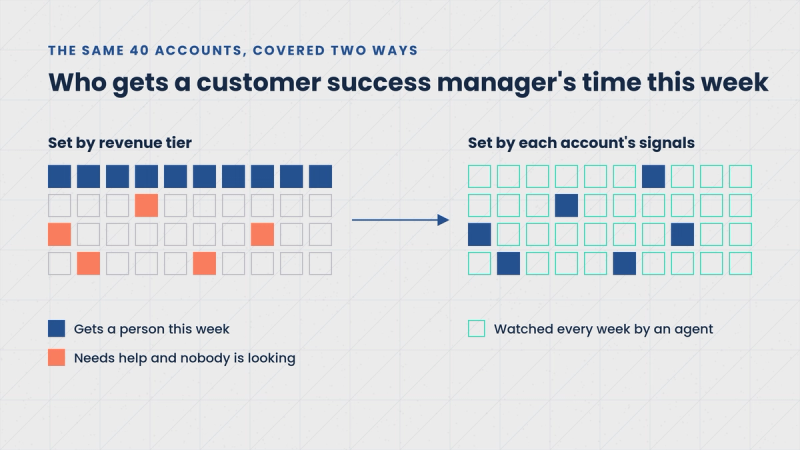
Consider a renewals team of four managers covering 600 accounts on annual contracts, with about 50 renewals coming due each month. Preparing each renewal call by hand takes most of a morning, so accounts that look healthy on the dashboard often get their first close look about thirty days before the renewal date.
The team runs the four questions over its renewal work and writes one Job for preparation. Each Monday the Job finds every account with a renewal in the next 120 days, about 200 accounts. For each one it pulls ninety days of usage against seats, open tickets, billing status and the open commitments from the last three calls, and it updates the renewal fields in the CRM. Where a Signal shows risk in the data, such as weekly active users down by a third or a key contact who has stopped replying, the Job drafts a renewal brief and sends it to the account owner in Slack. In a typical week it might flag 18 of the 200.
The four managers start each week with those 18 briefs. They review each one, add what they know about the customer, and book conversations with the at-risk accounts while three or four months remain on the contract. Price, discounts and terms are decided by the managers in those conversations, as they were before. The figures here are an example, and every team's thresholds will differ.
What this means for the renewal team
For a renewal leader, the change is in where the team's hours go. The assembly that used to fill the morning before each call is done for every account each week, including the ones that looked fine on the dashboard, and the managers' time goes to the conversations where something in the data says a person is needed. The question of which AI tool to buy then has a concrete answer, because the team knows which tasks it is buying the tool to do.