Gainsight, Vitally, and Planhat differ less on features than on what each is organized around.
Vitally vs Gainsight vs Planhat: Which customer success platform fits your team?

Vitally vs Gainsight vs Planhat: which customer success platform fits your team?
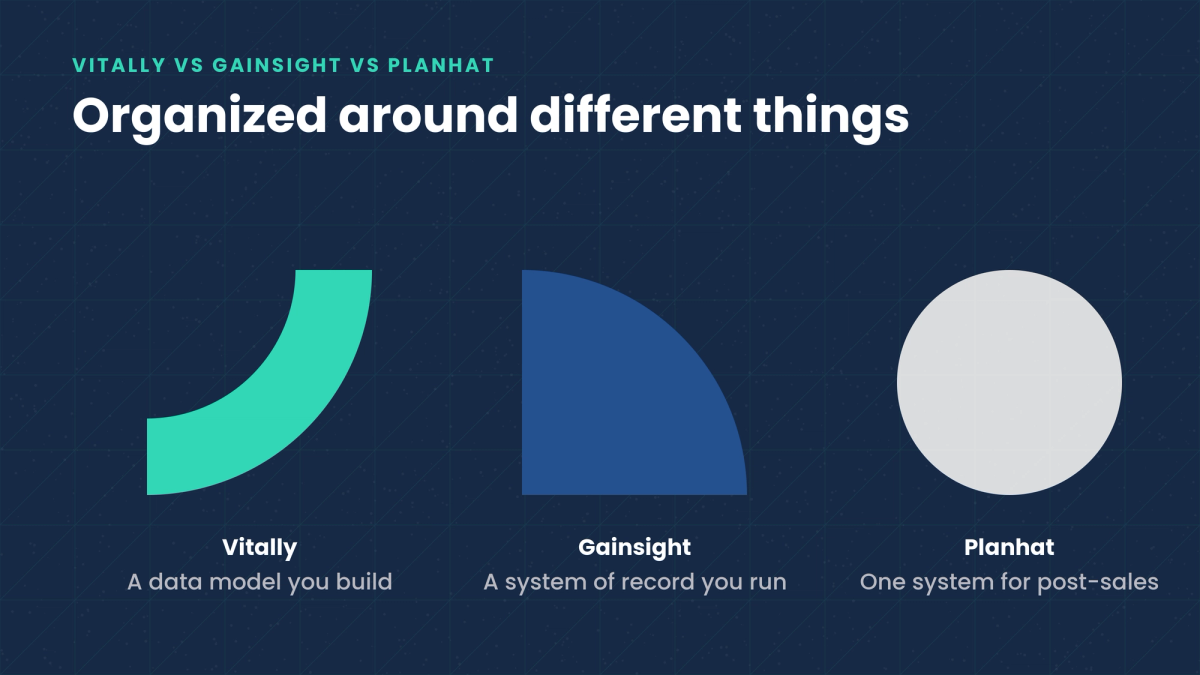
All three are customer success platforms, and they differ less on features than on what each one is organized around. Gainsight is a configurable system of record built for large post-sales organizations with operations support behind them. Vitally is organized around a configurable data model and the views a team builds on top of it. Planhat aims to be one system across customer success, account management, and services. The comparison that decides well starts from the shape of your team: how many people you have, what the system needs to hold, and who will spend part of their week operating it.
The three end up on the same shortlist because their demos look alike. Each shows health scores, account views, playbooks, and renewal tracking, and each can be configured to resemble the others for an hour. The differences appear later, in the third month of running the system, when someone has to maintain the structure the demo glossed over. That is why this page compares what each platform asks of the team that runs it.
The three platforms also share one assumption. Each is organized around human process: the platform assembles the picture (health scores, dashboards, playbooks, task queues) and people then work through what it surfaces. Trig is built on the other side of that assumption: AI agents carry out the account work itself. It’s a completely new model for how to think about managing and growing a customer base, without the limitations of human-led processes and capacity constraints. AI can now help you manage 100% of your customers.
| Option | Organized around | Tends to suit |
|---|---|---|
| Gainsight | A configurable system of record for large post-sales organizations | Enterprise teams with dedicated operations support |
| Vitally | A configurable data model and the views built on top of it | Teams with someone who will build and maintain the structure |
| Planhat | One system across customer success, account management and services | Companies wanting a single system for everything after the sale |
| Trig | Agents that carry out revenue work across every account | Teams whose constraint is coverage rather than reporting |
What Gainsight is organized around
Gainsight is a system of record for post-sales work at large organizations. Nearly everything about it can be configured: health scoring, lifecycle stages, playbooks, reporting, and the rules that connect them. For an enterprise team with hundreds of accounts spread across many owners, that configurability is the point, because the system can be shaped to match the organization's actual process at full depth.
The cost of that depth is administration. Gainsight installations tend to come with a dedicated operations owner, and often a formal customer success operations role, because scoring rules, playbooks, and reports drift out of date as the business changes. The platform rewards organizations that treat it as a system to be run.
What to check before committing: name the person who will administer it, and count their time as part of the cost. If nobody owns it, the configurability that makes Gainsight valuable to a staffed team becomes the reason the system goes stale.
What Vitally is organized around
Vitally is organized around its data model and the views built on top of it. A team defines the objects it cares about, brings in product and billing data, and builds the boards, docs, and dashboards it wants over that structure. Teams that like building their own working environment tend to get the most from it, and teams that want a finished process handed to them tend to find the blank page heavy.
The structure is both the asset and the ongoing work. Someone has to design it, and someone has to keep it current as segments, plans, and processes change. In practice that person is often a customer success leader or an operations-minded customer success manager who enjoys the building.
What to check before committing: whether the person who builds the initial structure will still own it a year in, and what happens to the views when they leave. A configurable model rewards a team that maintains it and punishes a team that set it up once.
What Planhat is organized around
Planhat positions itself as one system for everything after the sale: customer success, account management, and services working in the same place, over the same customer data. For a company consolidating post-sales tools, that breadth is the draw, because the renewal conversation, the expansion plan, and the delivery project can reference the same record.
A single-system purchase pays off when the functions actually move in. If account management keeps working from the CRM and services keeps its own project tool, the consolidated system becomes one more place to update.
What to check before committing: whether the other post-sales functions have agreed to work in it. That is an organizational decision no vendor can make for you, and it decides most of the value.
The three questions that help you decide
Stripped of the feature lists, the choice usually reduces to three questions.
- Who will operate the system? Gainsight assumes a staffed operations function. Vitally assumes a builder who stays. Planhat sits between the two, and all three go stale without a named owner.
- What does it need to hold? A focused customer success workflow suits a focused tool. All of post-sales in one place points to Planhat's breadth, and a deeply customized enterprise process points to Gainsight.
- Do you want to adopt structure or build it? Gainsight and Planhat hand you more prebuilt process; Vitally hands you the materials. Teams that know exactly how they work tend to build. Teams still finding their process tend to adopt.
How to run the evaluation
Run the pilot on your own accounts and your own data. Every platform demos well on the vendor's dataset, and the real differences show up in how much work it takes to make your data fit the model.
Write your renewal workflow down before the first call, then ask each vendor to build it end to end in front of you: from the signal, to the task, to the note that lands in the CRM. The steps that take the longest to configure in the demo are the ones that will take the longest to maintain in production.
Decide who operates the system before you sign. The evaluations that end well name the owner in week one, cost that person's time into the purchase, and confirm the owner actually likes the tool they will spend part of every week inside.
What to do if the real problem is capacity and coverage
Some teams comparing these three platforms are really shopping for coverage. Consider a team of five covering six hundred accounts: everyone knows what should happen on each account, and there are more accounts than hands, so renewal plays get skipped, follow-ups slip, and the CRM falls behind. A customer success platform gives that team a clearer picture of the work, and the team still has to do the work.
This is the boundary of the human-process model which all three of Gainsight, Vitally, and Planhat are built around. Trig is a different model for managing and growing a customer base. With Trig, you can deploy a team of specialist agents that carry out the account work itself — account research, renewal plays, follow-ups, CRM updates, pipeline reports — across the entire customer base. Agents can work across the tools the team already uses, and hunman approval is baked into any decisions where human judgement is necessary before any action is taken. Trig is also significantly faster to deploy, as it learns your company, products, and customers using your existing data.
The boundary is real in both directions. A team that wants a system of record, health scores it owns, and playbooks run by an operations function is describing a customer success platform, and one of the three above is the right buy. A team whose constraint is getting the work done on every account is describing the problem Trig is built for.
What the choice comes down to
Platform decisions in this category get lived with for years, so make the comparison on the parts that hold still. Pick the question that describes your team: who operates the system, what it must hold, and whether you build structure or adopt it. Answered honestly, those three usually name the platform for you. And if the honest answer to the first question is that nobody will run a platform at all, the problem is coverage, and that is the problem Trig takes on.