

What is the best AI software for managing B2B customer accounts?
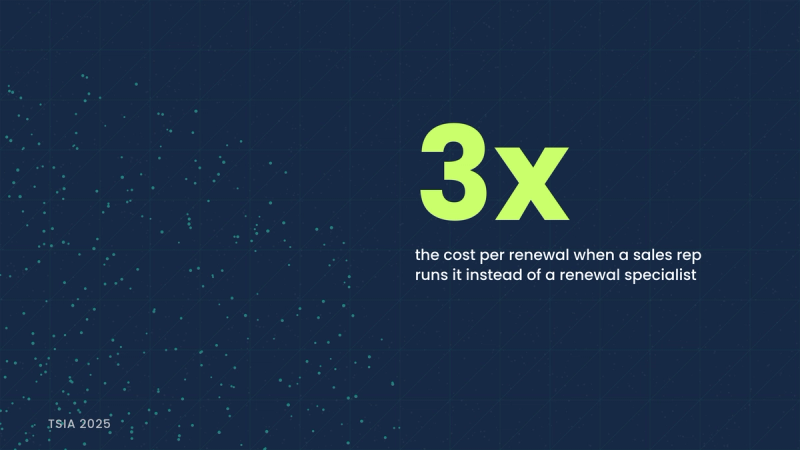
The measured answer starts with the role, because the roles have measurably different economics. TSIA's State of Customer Growth and Renewal report (2025) counted the cost of putting the wrong role on one part of post-sales work: companies that relied on sales executives to run medium-complexity renewals rather than dedicated renewal specialists paid three times as much per renewal, recorded net renewal rates 10 percent lower, and attached nearly 10 percent fewer upsells.
The AI tooling conversation mostly ignores this. Ask for the best AI tools for customer success, then ask again for account management or for revenue operations, and the lists that come back are mostly the same names making the same claims. Anyone who has run a post-sales team knows the roles are different jobs. The customer success manager is protecting time to value across too many accounts. The account manager is hunting expansion in a book that only gets attention when something breaks. Whoever owns the renewals, whether that is a dedicated specialist or the account manager, is working a contract calendar. RevOps is keeping the system underneath all three from drifting.
There is also a gap in the research to name. No published research yet answers the composition question for post-sales: nothing in the analyst or vendor literature maps which agents a customer success manager needs against which agents an account manager, a renewals owner, or a RevOps lead needs. What follows is a position, built from the decomposition rules the engineering literature has tested and the role differences the analyst houses have measured.
The org chart describes ownership. The work runs on context.
Anthropic's January 2026 guidance on multi-agent systems gives the rule that settles most composition questions: an agent that handles a piece of work should also handle the things that need the same context. Context here means the data a piece of work has to read, such as usage history, contract terms or open tickets. Dividing agents by type of work instead produces what the same guidance calls a telephone game, in which "the subagents spent more tokens on coordination than on actual work," and multi-agent setups already "typically use 3-10x more tokens" than a single agent. A team split in the wrong place spends its capacity on coordination before it produces any work.
The reason teams get this wrong is that the org chart is the division of labor they already have. Account ownership splits the work by who can be in the room, because a person can only be in one place at a time. An agent can read every account at once, so copying the org chart into an agent lineup reproduces a limit that no longer applies, and it separates agents from the context their work needs. The boundary that holds is the workflow and the context that workflow runs on.
Once the work is split by the data it reads, the buying question changes too. It stops being which tool each role should have and becomes which specialists each piece of work calls for, and who assembles them.
What Trig does about the composition question
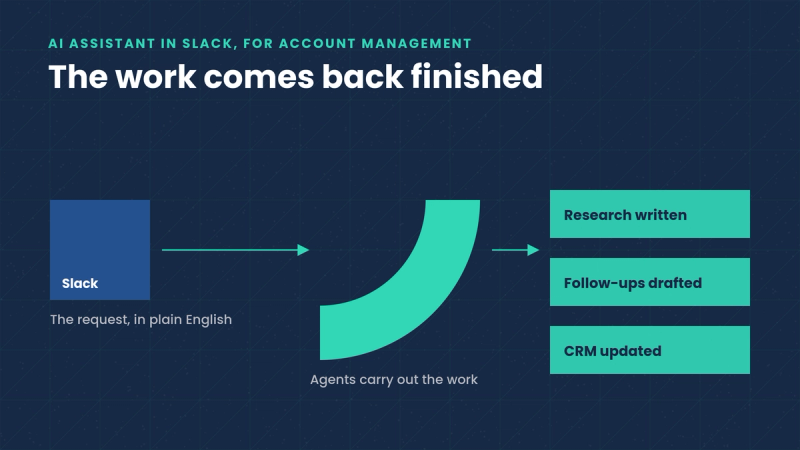
Trig is built on the context split. You set the goal, and Trig plans the work, builds a team of specialist agents to carry it out, and learns from the results. Each agent holds its own memory, its own tools, and a clean context window for the piece of work it is tuned for, and the Trig Context Engine unifies CRM, product, support, and billing data into a single living profile of every account, so each specialist reads the slice it needs without losing the rest. Human approval is baked into any decision where human judgment is necessary, so the irreversible calls stay with the person running the book.
Because each goal runs on different context, the same product produces a different team for each piece of the work, and one person directs as many teams as the pieces they own. Here is what those teams look like across the work a post-sales team holds.
The agent team for each piece of post-sales work
AI agents for a customer success manager
The customer success manager's work runs on the account's usage and experience, and coverage is the standing problem. TSIA names the barriers that have always capped the role: "Too many accounts, not enough people… Important accounts slipped through the cracks… Data lacked an execution layer" (TSIA, 2025 and 2026). Past the first handful of accounts, everything else is managed on whatever attention is left over.
The specialists that share this context are an onboarding tracker that follows every new customer to first value and names who has stalled and why, an adoption analyst that watches feature usage across the book and flags the drops, a health reader that connects usage, support tickets, and champion activity into an early churn signal, and a briefing specialist that assembles the quarterly business review or the renewal picture before the meeting. On a book of fifty accounts, that turns a Monday spent choosing which ten to look at into a Monday spent on the three where the call is hard. The human keeps the relationship, the difficult conversation, and the judgment about which flagged risks are real.
AI tools for proactive customer account management
The account manager's growth work runs on the commercial relationship. The team here is an expansion analyst that spots the usage and stakeholder changes that precede an upsell and drafts the outreach, a prioritization specialist that says each morning which accounts need attention and why, a renewal-brief preparer that pulls contract dates, contact history, and usage trends before every call, and an account-plan builder that assembles goals, stakeholders, and next steps on demand. The human keeps the negotiation, the pricing judgment, and the decision about when to push.
AI agents for renewals
The renewal work runs on the contract and its risk. In many teams the account manager owns the renewal, and the composition holds either way: the renewal reads different data than the expansion work, so the same person directs a different team for each. TSIA's renewal cost finding belongs here: the specialist beat the generalist on cost, renewal rate and upsell, and the same report adds that "AI-driven revenue operations can significantly expand the scope of work per renewal specialist." AI grows the book one specialist can carry, and the specialism itself stays. The team is a contract watcher holding dates, terms, and pricing history, a risk scorer, a save-play drafter, and a long-tail runner for the renewal segments too small for human outreach to have ever been viable. The human keeps the escalated save, the concession decision, and the executive-level intervention.
AI tools for RevOps teams to automate CRM admin
RevOps work runs on a different kind of context: the data and the workflows the rest of the team depends on, spanning every account at once. The team here is a hygiene agent that watches for duplicate accounts, stale opportunities, and missing fields, fixes what is safe to fix, and surfaces the exceptions for review, a report builder that posts on whatever cadence the team sets, a forecast-variance analyst, and the recurring workflows that have sat on the backlog for months. The human keeps the design of what gets measured and the decision about what an agent may change without review.
Across all four, the pattern holds. The specialists differ because the context differs, and the human keeps the judgment, the relationship, and the irreversible decision.
How many people this takes
McKinsey reports, from its own consulting experience rather than from research, that a human team of two to five people can supervise 50 to 100 specialized agents running an end-to-end process. Whether that ratio holds for a post-sales book is untested, and it is worth being suspicious of any vendor quoting a firmer number, because no study has established one.
What stays in place is the role itself. TSIA's renewal finding measures specialization paying for itself, and the agent team's job is to extend how much book one specialist can cover. The judgment stays with the person in the role.
What this changes for a post-sales team
A head of customer success or account management evaluating AI this quarter is choosing a division of labor. The org chart keeps describing who owns the customer. The agent team describes what reads the data, and the reading is where the hours have been going. A team that gives each piece of the work the specialists its context calls for gets coverage of the whole book, and its people spend their time on the conversations, the negotiations, and the judgment calls that need a person in the room.