


Will AI replace account managers and customer success managers?
An account manager's week holds two kinds of work. The first is preparation: pulling usage from the product dashboard before a renewal call, reading back through support tickets, writing up call notes, updating the CRM and building the slides for next month's business review. The second is what all that preparation is for: deciding which customers need help, telling a sponsor something they would prefer not to hear, and agreeing a price. AI agents can now do much of the first kind of work, and account management and customer success leaders are starting to ask what happens to the people who used to do it.
TSIA's State of Customer Success 2026 report describes AI moving from "a tool that helps you automate tasks" to "the operating fabric of CS." In TSIA's reading, customer success managers become value managers, the customer success and sales motions converge, and digital customer success covers the whole customer base, enterprise accounts included.
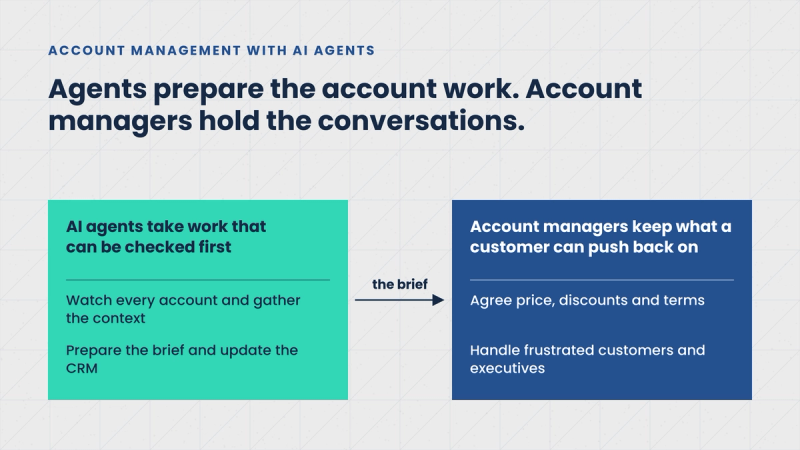
The short answer is that AI will take over a large share of the tasks in these roles, and what happens to the role itself depends on how its leader redesigns it. Research across the wider workforce shows the same job can go two ways. In one version, AI takes the routine work and the person keeps the expert work. In the other, AI does the work and the person's part shrinks to checking it. For account managers and customer success managers, the first version means agents prepare every account while people spend their time on judgment, relationships and commercial decisions.
What the research says about AI and account management jobs
Nobody has measured this directly for post-sales teams. The research behind this piece found no independent study of how customer success managers, account managers or renewals managers spend their time, and none of the large studies of AI exposure has an occupation category for these roles. No independent study has yet compared retention, cost to serve or time to value for a team that reorganized its work around AI with a team that automated the tasks it already had.
The closest evidence covers the whole economy. PwC's 2026 Global AI Jobs Barometer, a consultancy study built on large sets of administrative data, compared jobs by what AI does inside them. Jobs where AI takes over the basic work and people keep the expert work grew 39%, compared with 17% on the other track, and salaries grew 42% faster. PwC's figures show a correlation, and they do not single out customer success managers. In PwC's data, the version of a job that keeps the expert work grew faster and paid more, and account managers and customer success managers can end up in either version.
Why the same AI produces different jobs in different teams
Which version a team ends up with depends mostly on how the team is managed. Nicholas Bloom, Raffaella Sadun and John Van Reenen showed this for an earlier generation of technology in a 2012 paper in the American Economic Review. US multinationals operating in Europe got more out of the same information technology than other firms in the same countries, and the difference came from their management practices.
DORA's 2025 report on AI in software development, a survey of about 5,000 professionals run by Google, found the same pattern with AI. The report concludes that AI "magnif[ies] the strengths of high-performing organizations and the dysfunctions of struggling ones." That finding comes from software teams, and it fits post-sales work closely. If a customer success manager's job is defined as a list of tasks for each account, AI completes the list faster and the job becomes checking the output. If the job is defined by the decisions each account needs, AI clears away the preparation and leaves more of the week for those decisions.
Is AI making account managers more productive? What the field studies show
The strongest field evidence on AI and productivity in customer-facing work comes from customer support, a neighboring function. Erik Brynjolfsson, Danielle Li and Lindsey Raymond studied 5,172 support agents in a paper published in the Quarterly Journal of Economics in 2025. An AI assistant raised productivity by 14% on average and by 34% for newer agents, while the top performers saw small declines in the quality of their work.
Support agents do a different job from account managers, and this is the only study from outside post-sales in this piece. It still holds a lesson for a post-sales leader. AI helped newer people the most, which suggests it was supplying experience they did not yet have. The top performers gained the least, and the quality of their work fell slightly. An assistant spread evenly across the whole job reaches the experienced person's decisions as well, and that is where the study found the small declines in quality. Giving agents the preparation and leaving the decisions with experienced people keeps AI on the part of the job where the gains were largest.
Should customer success and account management be one role?
Many post-sales teams split each customer between two people: a customer success manager who looks after adoption and health, and an account manager who owns the commercial relationship. Much of that split exists because one person cannot do all the preparation for both jobs across a full book of accounts.
A randomized experiment published as "The Cybernetic Teammate" (NBER, 2025, and Organization Science, 2026) tested 776 professionals at Procter & Gamble. Individuals working with AI matched the output of two-person teams working without it, and AI helped people work across functional lines they would normally have left to a colleague. The experiment was about product work and says nothing direct about customer accounts. Read alongside TSIA's finding that the customer success and sales motions are converging, it suggests that one account owner, with agents doing the preparation, can cover both the adoption work and the commercial work for an account.
What the expert version of the role looks like in post-sales
The two versions of the role are easiest to see in the work itself. In the version that grows, the work divides like this:
- Agents do the work that is high in volume and easy to check. That means watching usage and support activity across every account, keeping CRM records current, writing up call notes, and assembling briefs and reports before meetings and renewals.
- Agents prepare the work and people deliver it. Renewal reports, expansion cases, meeting briefs and account plans are drafted by agents and then used by a person in a conversation with the customer.
- People lead the moments that decide the relationship. Pricing, discounts and contract terms, executive relationships, frustrated or escalated customers, and expansion conversations stay with the account owner, and agents supply the context.
In the version that shrinks, AI writes the emails and the person approves and sends them while the number of accounts each person covers keeps rising. The job becomes reviewing output for more customers than anyone can know well, and the judgment the role existed for has no time left in the week.
How Trig gives account owners the expert version of the role
Trig is an agent-powered workspace for account management and customer success. AI agents do recurring account work, and the team directs and reviews it. Work in Trig is defined as an assignment, which sets out what to produce, which accounts to work on, who receives the work, when it runs, and what agents may read and do. Before an assignment runs, the team reviews Trig's plan, which shows the information it will use, the actions it will take and the work it will produce.
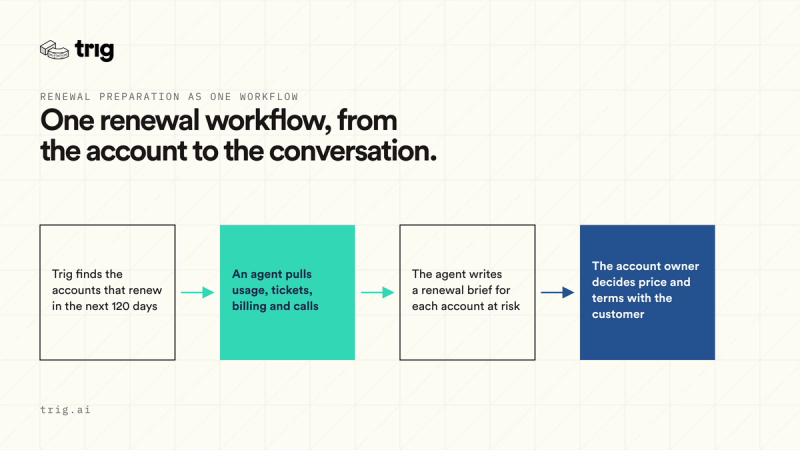
The templates Trig includes sit on the agent side of that division. They prepare a brief for every customer meeting on the calendar, assemble a renewal report two weeks before each renewal, write the next steps, risks and new contacts from each call to the CRM record, and rank the accounts whose usage is falling each week by renewal value. Where the work is commercial, agents prepare it for a person. When a renewal reaches negotiation, a proposal based on list pricing is ready for the account owner to review.
Agents work from a profile of each account that combines CRM, product, support and billing data with conversations and previous agent work. Trig's Control Panel organizes that work around reps, teams and customer groups. A rep sees the briefs and reports prepared for their own accounts, a team lead sees which accounts each assignment covers and what agents produced for each rep, and anyone picking up a colleague's account has the previous agent work and context in front of them. Customer alerts and any work that needs a person to step in collect in one view, called Needs you.
What this looks like in practice
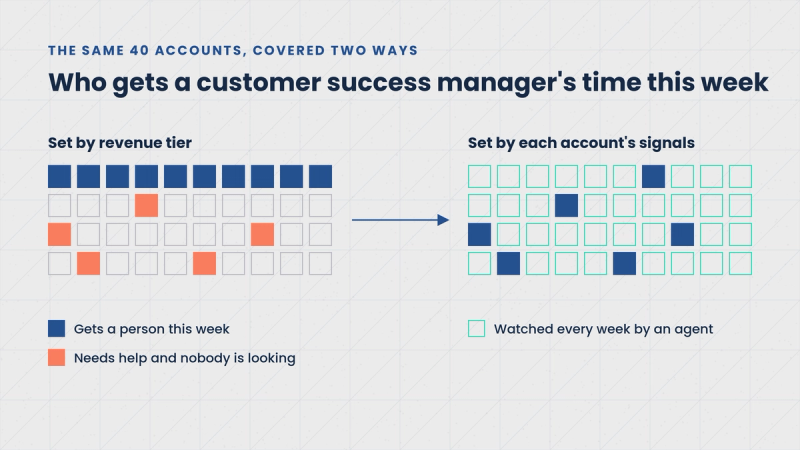
Consider a post-sales team of eight covering 600 accounts: four customer success managers looking after adoption, and four account managers owning renewals and expansion, with each account split between two people. In a typical week, both people on an account spend time pulling the same usage figures and reading the same tickets before their calls, and the 300 smallest accounts get a quarterly email and little else.
The head of account management moves the preparation into four assignments:
- A brief before every customer meeting, covering recent changes and open commitments.
- A renewal report two weeks before each renewal, for every renewing account.
- Call notes and next steps written to the CRM after each customer call.
- A weekly list of accounts whose usage is falling, ranked by renewal value.
The team then gives each account a single owner, who reads the brief, has the conversation, makes the commercial calls and decides what to do about each flagged account. The team lead reviews each plan before it runs and checks the first reports line by line. These figures are an example, and every team will draw its own lines between agent work and people's work.
What this means for account managers and customer success managers
For the people in these roles, the risk from AI is a job redesigned around checking AI's output for an ever larger book. The opportunity is a job where agents prepare every account and the person spends the week on the decisions and conversations that experience is for. Leaders choose between those two versions each time they decide what agents work on and what stays with people.